

At the recent WGIC Horizons conference in London, the mood was one of cautious excitement. The topics centered around big picture themes about navigating questions of trust and purpose in an industry that finds itself suddenly equipped with remarkable new tools. The keynote address set the tone to be optimistic about the technology, but was clear-eyed about its implications.
The session opened with a question that felt almost philosophical: do those working in geospatial technology truly think of themselves as geographers? Not by academic training, but by instinct and practice. These are people who look at the world and want to understand it.
Geographers, the conference heard, have always occupied a unique position. They don’t just describe the world; they explain why the world is the way it is. That explanatory role, grounded in the principle that near things are more related to each other than distant things, underpins everything from mobile navigation to intelligence analysis. However, as technology has made describing the world faster and easier than ever, there is a risk that the deeper work of geographic explanation gets crowded out. The call at WGIC Horizons was to refocus on that foundational value.
The Same Problems, Radically Different Solutions
A recurring theme of the conference was that humanity tends to return to the same fundamental problems, solving them with the tools available at the time, sometimes incrementally, sometimes in ways that break entirely with the past. The contrast between iterative and radical progress was illustrated vividly.
Space exploration was offered as an example of incremental change: today’s missions to the Moon rely on broadly similar rocket architecture to those of the 1960s. However, in the field of geospatial intelligence, the contrast between eras is stark. Cold War-era satellites captured imagery on physical film, dropped canisters from orbit, and delivered intelligence weeks or months after the fact, often too late to be of use. One proposed solution of that era was to put trained human observers directly into orbit to radio intelligence back in near real time. That programme was cancelled before it ever launched.
Today’s answer is entirely different: AI deployed on board satellites themselves, capable of identifying objects of interest autonomously and transmitting actionable intelligence directly to the ground. The problem being solved is the same. The approach is unrecognisable. The conference drew a clear lesson from this: the question worth asking is not how to do existing things better, but what a radically different approach might look like.
From Rules to Probability
The central trust challenge facing the industry stems from a fundamental change in how technology works. For decades, software was deterministic: define the rules, and the system behaves predictably. AI systems, particularly machine learning and large language models, are probabilistic by design. They don’t follow rules so much as make informed bets based on patterns in data.
“By design, they’re harder to understand,” the audience was told. “And that clearly is really important to society. We need to be able to explain why we’ve made the decisions that we have done.”
This is not merely a technical distinction. It has real consequences for governance, liability, and public confidence. As geospatial data increasingly feeds decision-making in defence, urban planning, autonomous vehicles, emergency response, and beyond, the stakes of an unexplainable or incorrect output rise sharply. The industry cannot simply deliver powerful tools and leave the question of interpretability to others. Explainability, the conference heard, must be built in from the start.
The Human in the Loop
Running through the day’s discussions was the question of where humans sit in AI-assisted decision-making. Automation has always advanced in waves: agriculture, manufacturing, logistics, and now cognition itself. The trajectory is consistent, but each step raises new questions about what should and shouldn’t be handed over to machines.
The example of autonomous vehicles was used to bring the question into sharp relief. Fully self-driving taxis are already operational in several US cities, and the technology is now being adapted for London’s streets. The navigation challenge is, in theory, entirely solvable by AI. Yet the question was posed directly: even if a machine can drive better than a human, does society still want a person behind the wheel? Is there something valuable socially and psychologically about human presence in a system that affects people’s safety and daily lives?
“There is a role for the human in the loop,” the conference heard. “There is a role for humans in building these world models. There is a role in us checking that what is happening is as expected.” Precisely where that role begins and ends was left as an open question, acknowledged as one of the defining challenges of the current era, not just for geospatial professionals but for society as a whole.
Maps as Decision Layers
Perhaps the most consequential shift discussed at WGIC Horizons was the evolution of maps from neutral representations of the world into what were termed “decision layers” which were described as datasets embedded with machine learning, designed not for general use but to support specific, high-stakes choices. Military and intelligence applications were cited as examples where sensor data, satellite imagery, open-source information, and AI models are already being combined to produce real-time operational pictures and recommended courses of action.
The implications extend well beyond defence. In urban management, infrastructure planning, climate response, and public health, the same logic applies: the value of geospatial data lies increasingly not in the map itself, but in what the map recommends. Geospatial professionals, the conference was told, must step into this space rather than observe it from a distance. “We need to embed ourselves in these processes,” delegates heard. The profession’s role is shifting from building mirrors of the world to building engines that are actionable, systems that change and respond on a daily basis.
This requires a different kind of engagement: less abstract, closer to the end user, and more directly accountable for the outputs that are produced. It also requires the geospatial community to grapple seriously with the ethical dimensions of systems designed to drive decisions at speed and scale.
Here Be Dragons
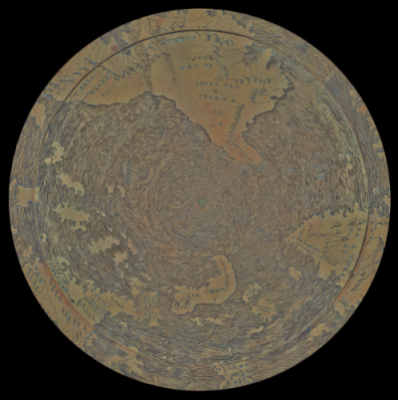 The session closed with a reference to one of the world’s earliest globes, which bears the inscription Hic sunt dracones (here be dragons) over an uncharted stretch of ocean. The image resonated with the mood of the conference: there is genuine excitement about what the technology can do, and genuine uncertainty about what lies ahead.
The optimism at WGIC Horizons was real. The geospatial profession is better placed than almost any other to shape how AI-driven world models are built, how decision layers are constructed, and how the outputs of these systems are interpreted and validated.
However, that opportunity comes with responsibility. Trust in AI will not be given freely. It will need to be earned through transparency, through explainability, and through keeping human judgement at the centre of systems that increasingly shape the world around us.