

Four major announcements across just a few days don’t often happen in the architecture, engineering and construction (AEC) technology market. Between June 17 and June 30, 2026, four industry brands unveiled platforms and secured significant funding to expand the artificial intelligence capabilities of their software. While each announcement addresses a different aspect of building information modeling (BIM), together they suggest the market may have reached a turning point.
Advances in AI, growing confidence in digital workflows and increasing demand for measurable productivity gains are converging, accelerating the adoption of AI construction tools across the AEC technology sector.
Four Announcements, One Clear Direction
Although the four June announcements involved different products and business models, they all point toward the same objective of reducing the manual effort required with BIM automation.
| Company | Date | Announcement | Focus |
| Trunk Tools | June 17 | Launched Cortex, based on real receipts with a custom-built AI | AI-powered knowledge management that connects project documentation with BIM and construction technology trends. |
| Beam AI | June 22 | Introduced BIM CoPilot with human-vetted automated workflows | An AI assistant designed to automate repetitive BIM tasks and improve design productivity across pre-, current-, and post-construction phases. |
| QikBIM | June 24 | Official platform launch | AI-driven BIM automation focused on accelerating modeling and documentation workflows, including mechanical, electrical and plumbing (MEP) engineering designs. |
| Higharc | June 30 | Raised $95 million in Series C funding | Investment to expand AI-powered residential design and homebuilding automation. |
Trunk Tools focuses on connecting fragmented project information, Beam AI targets day-to-day modeling workflows, QikBIM emphasizes automation during model creation and Higharc applies AI to residential design and construction. When viewed together, the announcements reveal a broader industry shift.
Rather than replacing BIM platforms, each solution builds on existing workflows by automating repetitive tasks, improving access to project data or accelerating design decisions. The emphasis has moved away from simply digitizing construction data toward making its processes more intelligent and efficient.
The shared direction makes the timing interesting. Four separate companies identified similar opportunities just before the start of the peak summer building period. It suggests the industry’s priorities have rapidly evolved beyond isolated AI architecture and are fast-tracking toward practical applications capable of delivering measurable, receipt-proven value.
Technology and the Market Are Finally Caught Up
The clustered announcements weren’t simply the result of several companies choosing the same pre-summer launch window. They arrived as the AEC industry reached a point where AI had shifted from an emerging technology to a business tool expected to deliver measurable results.
The “State of Design & Make: AI Pulse 2026” report shows that organizations are pursuing new ways to use advanced systems, including AI, after previously focusing on access. Further findings indicate 42% of organizations are digitally mature, with 19% already using AI in their daily workflows.
Rather than ask whether AI belongs in design workflows, many firms are now focused on where it can generate the greatest operational value. The momentum extends across the industry, with the “2026 AEC Inspire Report” now finding that 75% of AEC entities adopt AI technology, which is a marked increase from the previous year.
However, uncertainty remains, with the “AI + Data Insights 2026: Global AEC Industry Report” revealing that only 22% of AEC firms see themselves as fully prepared to adopt AI technology. Data quality, security and better governance remain significant concerns, while just 38% of employees at firms believe their organizations are using AI in alignment with the broader business objectives.
Together, these findings describe a market that has entered a new phase. While AI is no longer viewed as experimental, firms are becoming more selective about where they invest. Instead of pursuing technology for its novelty, they increasingly expect automation to solve specific workflow challenges, improve productivity and demonstrate measurable returns. That changing mindset creates fertile ground for June’s wave of AI construction tools and BIM automation platforms.
AI Technologies Are Reaching Practical Maturity
The recent wave of BIM automation platforms reflects the convergence of several artificial intelligence technologies that have matured enough to support production environments instead of demonstrations.
Large language models now make it possible to search thousands of project documents, specifications and BIM records using natural language, allowing project teams to retrieve information in seconds instead of manually searching through files. Computer vision has improved the ability to interpret drawings, plans and site imagery, while generative AI can automate repetitive modeling, documentation and coordination tasks that traditionally required significant manual effort.
The June launches demonstrate how these capabilities are being applied to different stages of the project life cycle. The increased capacity and proven skills of AI agents come at the right time, with labor shortages threatening the construction industry. New BIM platforms with on-site training can help bridge knowledge gaps and keep workflows aligned. With mounting labor and expertise shortages, AI and machine learning have become two of the fastest-growing segments. Adoption remains relatively low, leaving room for expansion.
Rather than introducing entirely new methods, today’s AI construction tools are increasingly designed to integrate with the digital processes that many firms have already established. That evolution lowers adoption barriers and helps explain why several companies were ready to bring mature AI products to market at nearly the same time.
BIM’s Growth Is Creating More Automation Opportunities
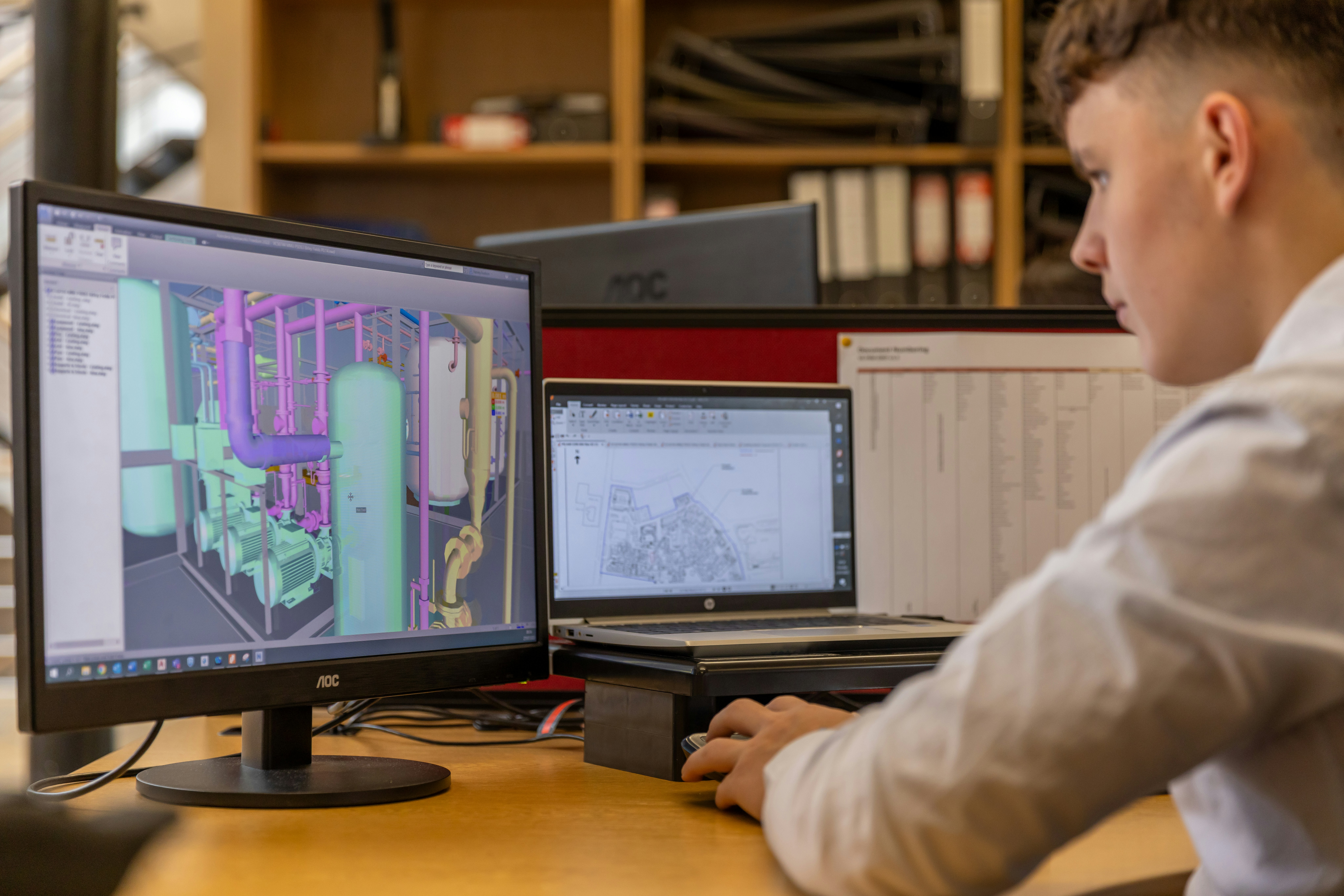
AI and BIM are both entering a new stage of maturity. As models become more detailed and project teams generate larger volumes of connected data, coordinating information across disciplines becomes increasingly time-consuming.
Conservative reports project the BIM market may grow to $15.42 billion by 2030. Other reports estimate that in 2024, the BIM market reached $23.5 billion, but it may exceed $38 billion by 2029, with data management and construction workflows among the fastest-growing segments. The technology is becoming widely adopted by architects and engineering firms as digital delivery becomes standard practice.
The growth addresses increasing complexity across projects and building legislation. Coordinating the building process with mechanical, electrical and plumbing (MEP) systems requires engineering designs that affect the cost-effectiveness of utility layouts from planning to construction.
Firms specializing in integrated MEP design coordination have long relied on collaborative workflows to improve constructability, building performance and long-term operational efficiency. AI is increasingly being applied to automate portions of that coordination rather than replace the engineering expertise behind it.
The same principle extends beyond individual buildings. As BIM becomes more closely connected with infrastructure planning, digital twins and sustainable development initiatives, interoperability between platforms becomes increasingly important.
That broader integration is one reason why BIM has wider applications, such as integrating sustainability technologies across building components and extending into citywide applications. Stormwater management for sustainable cities is one such area where connected data supports planning and modeling across multiple systems. As BIM datasets continue to grow in size and complexity, AI can help project teams manage information that would otherwise be difficult to process efficiently.
What These Launches Signal for BIM Workflows
Despite their differences, all four announcements target the same bottleneck in the time professionals spend searching for information, coordinating models and completing repetitive documentation tasks. Rather than changing BIM itself, AI is changing how teams interact with it.
Emerging platforms embed natural-language search, automated clash detection, document summarization, model generation and intelligent recommendations directly into existing workflows. The goal is to reduce administrative effort, so architects and engineers can focus on higher-value design and coordination.
The shift also reflects changing buyer expectations. Firms are increasingly prioritizing AI tools that integrate with established BIM ecosystems, support multidisciplinary collaboration and deliver measurable productivity gains.
Whether June’s announcements mark a lasting inflection point remains to be seen. What is already clear is that AI is becoming an integrated layer of the BIM workflow rather than a stand-alone technology.
Looking Beyond June
This summer building season may see AI integrate with BIM platforms as companies create better houses and more sustainable skyscrapers that meet changing needs. Whether the concentration of announcements in June was a coincidence or careful timing, it highlights a broader shift in the architecture, engineering and construction industry. AI has repositioned from a future capability to a practical way to improve BIM workflows, reduce repetitive work and help teams make better use of project data.


