The BIM Challenge, organized by ALLBIM NET, is a student BIM Summer School and professional conference designed to bring future AEC professionals closer to the collaborative workflows they will encounter in practice. In 2026, the event reached its 20th edition and, for the first time in its history, welcomed international participants.
Held from 24 to 29 August at Ovidius University of Constanța, Romania, this year’s edition brought together 95 students from architecture, structural engineering, building services, urban planning, landscape architecture and infrastructure. Working in eight multidisciplinary teams, they had five days to turn a real brief into a coordinated digital project.
Alongside the student workshop, The BIM Challenge also included a two-day professional conference, bringing students into the same environment as engineers, BIM specialists, software developers and construction professionals discussing interoperability, AI, digital twins, 4D planning and the future of digital collaboration in AEC.

But this year’s challenge went beyond learning individual software tools. Students were asked to use them together.
Working on the design of a modular student hub on a real site within the Ovidius University campus, the eight teams developed their projects through a complete openBIM workflow, from site analysis and early concept design to discipline-specific development, coordination and a final federated model.
For many participants, the challenge was also their first hands-on experience with a Common Data Environment (CDE). Using BIMPLUS as the shared environment for coordination meant learning how different disciplines contribute to the same project information, how changes can be traced, and how a single source of truth becomes essential once several teams and software environments are involved.
“It was important for us that students understood how essential transparency and traceability become once you start thinking about a project across its entire lifecycle,” said Monica Amuza, The BIM Challenge Coordinator. “Digital tools allow them to coordinate and collaborate efficiently, but they also need to understand that they are part of a much larger ecosystem, working alongside people from other disciplines. For many of them, this was their first experience with a Common Data Environment such as BIMPLUS and with an openBIM workflow. They could see first-hand why a project needs a reliable single source of truth.”
Throughout the week, students worked with ALLPLAN, BIMPLUS, SCIA Engineer, Bluebeam Revu, GEO5, AX3000 and Lumion, experiencing something that is still difficult to reproduce in a traditional university setting: what happens when several disciplines, several software environments and dozens of decisions have to come together in one project.
Software was not the assignment. The project was.
That distinction was at the heart of The BIM Challenge 2026. Rather than testing students on isolated software capabilities, the workshop challenged them to decide which digital tool made sense at each stage of the process, how information should move between disciplines and platforms, and how a shared model evolves when several people are contributing to it simultaneously. The objective was interoperability rather than proficiency in a single application.
The result was five days of designing, modelling, calculating, reviewing, coordinating, visualizing, and occasionally going back to fix something that worked perfectly well before another discipline entered the model.
In other words, a rather realistic introduction to BIM.
A major addition to the 2026 edition was the mentorship format. Each student team was paired with a company or professional organization for the entire week. Engineers, BIM coordinators, trainers, and industry professionals worked directly alongside the students, helping them solve technical tasks and understand the reasoning behind decisions that software alone cannot make.
The eight mentoring organisations were STRABAG Romania, CELCO, ALLPLAN, Concrete Design & Solutions, Clivet, VISE Smart Building, ANAZ and OAER, together with AIIR.


ALLPLAN takes the challenge from the workshop to the stage
ALLPLAN had a particularly strong presence throughout the 2026 edition, as both a software partner and a mentor.
The ALLPLAN student team worked throughout the week with Mikko Stachl, BIM Specialist; Ashef Rahmatullah, Education Manager; and Louis Dessainte, Civil Engineer & Trainer, ultimately taking third place in the competition.

The experience also created an unusual connection between the workshop and the professional conference running at the end of the week. The same specialists who had spent days working directly with students stepped onto the conference stage to discuss interoperability, education and the changing role of digital tools in AEC.
Mikko Stachl presented AutoConverter, demonstrating a workflow between ALLPLAN and SCIA Engineer in which a structural model created in ALLPLAN can move into structural analysis without having to be rebuilt from scratch.
The demonstration addressed one of the most practical questions behind digital collaboration: how much work can be preserved when information moves from one specialist and one software environment to another?
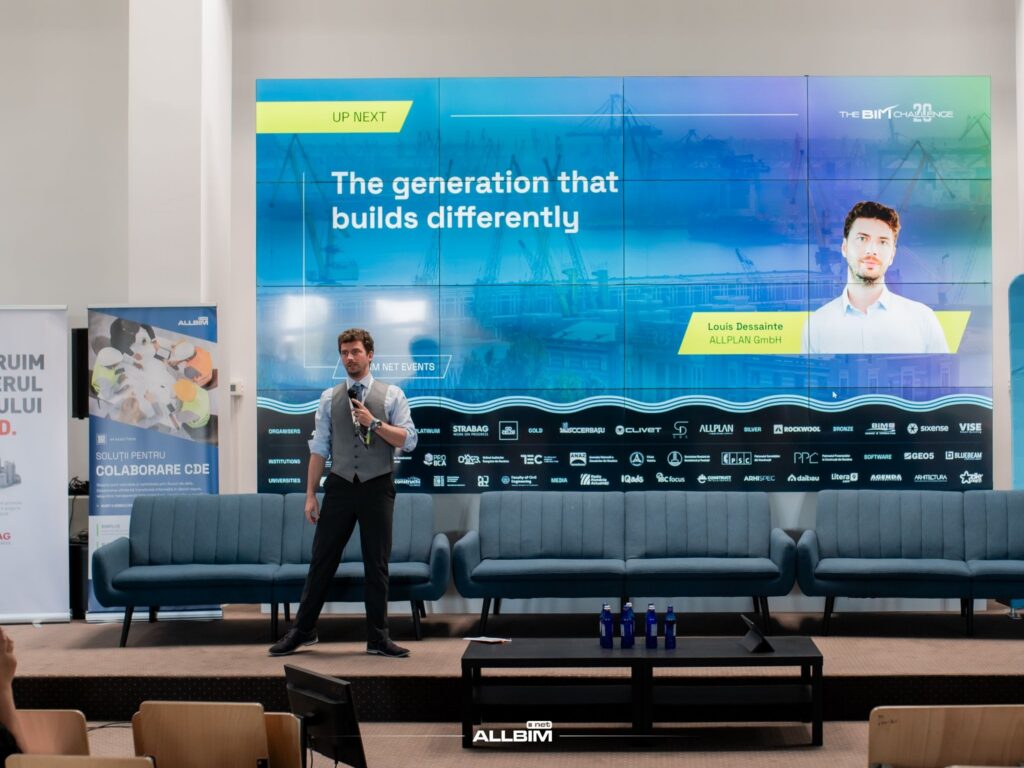
Meanwhile, Louis Dessainte brought the perspective of both engineer and mentor to his session on the next generation of AEC professionals. His message was fitting for a week built around learning by doing: technology changes quickly, but the ability to keep learning remains one of the industry’s most valuable skills.
What happens when AI enters the BIM workflow?
Software discussions at The BIM Challenge were not limited to modelling and interoperability.
One conference session looked directly at how AI is beginning to enter everyday AEC workflows.
Bogdan Cucoș, founder of KUKONSTRUCT, presented AI tools he developed and connected to ALLPLAN to automate repetitive work in his own engineering practice. The discussion focused less on AI as a distant promise and more on a very practical question: what work should engineers still spend their time doing when software can take over repetitive tasks?
George Călin and Nadiia Badruk of ALLBIM NET also explored the changing software landscape across design, construction, site coordination and asset monitoring, including the integration of AI into ALLPLAN, GIS-based urban planning documentation, GoCanvas, SiteDocs and dTwin.
The common thread was clear: the next generation of AEC software is increasingly less about isolated applications and more about connected information, interoperability and reducing the distance between a decision and the people who need to act on it.

From model to site, and beyond handover
That idea continued throughout the professional conference. Michael Havran of Bluebeam focused on decision visibility and the cost of working with outdated or fragmented information, summed up in one of the most memorable lines of the event:
“The most expensive words on a project? I thought…”
His sessions explored how teams can work with live information across office and site environments, turning digital collaboration into something much more concrete than simply exchanging files.
The program also moved beyond design and construction.
A session dedicated to digital twins, led by George Călin of ALLBIM NET and Mihai Pavel, Founder & CEO of VISE Smart Building, explored what happens to building data after handover. A live sensor demonstration in the conference foyer allowed participants to see the connection between the BIM model, the physical asset and operational data in real time.
Chris Ray, Head of Digital Construction Solutions at Eleco, added time to the equation with a live demonstration of 4D planning, marking the pre-launch of Asta Powerproject on the Romanian market ahead of its official launch planned for early 2027.
The conference also addressed ISO 19650 implementation, GIS-BIM integration, digital documentation, data-driven investment decisions and the information requirements of high-performance buildings, connecting software development with the wider transformation taking place across the European AEC industry.

A software ecosystem only makes sense when people can work across it
Perhaps the most interesting outcome of the week was not any single model, application or feature. It was watching 95 students discover that BIM becomes considerably more interesting, and considerably more difficult, once architecture, structures, MEP, infrastructure and other disciplines have to coexist.
The BIM Challenge was created precisely for that moment. Students were not given five days to become experts in every platform. They were given five days to understand how digital tools, information, and people connect around the same project.
And they did it with experienced industry professionals sitting at the same table.
The competition ended with the team mentored by STRABAG Romania taking first place, followed by Concrete Design & Solutions in second place and ALLPLAN in third. The team mentored by ANAZ received the Audience Award, decided through an Instagram vote.
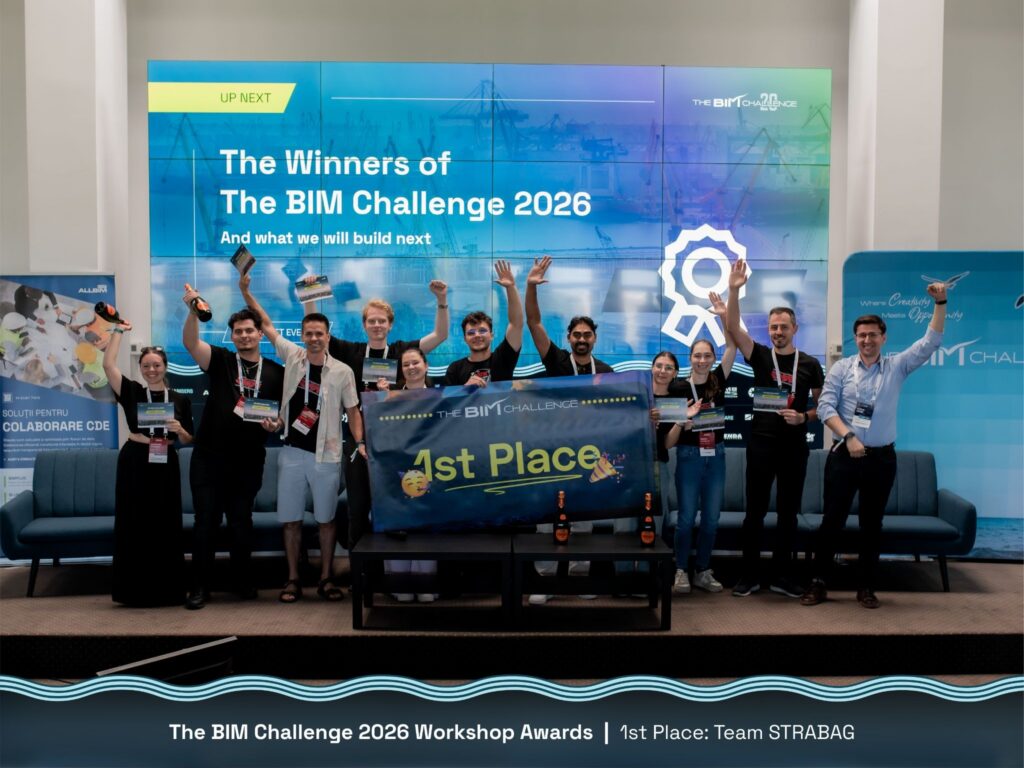
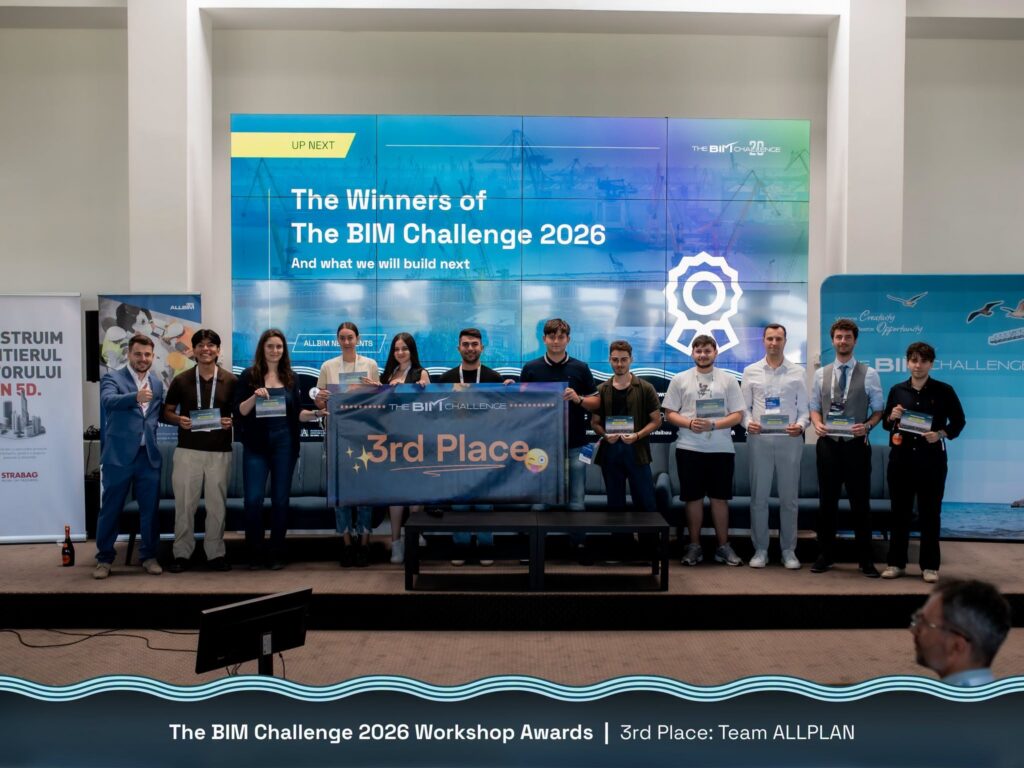
For the organizers, however, the ranking is only one part of the story. The larger goal is to expose students to the kind of digital collaboration they will encounter after graduation, while giving software developers, engineering companies and construction professionals a direct connection to the people who will soon be using these technologies on real projects.
“There were plenty of challenges beyond the technical side,” Monica Amuza added. “Communication was a very human one. Students were working with people from different countries, different disciplines and even different engineering schools, with different approaches to the same problems. By the end of the week, however, you could see those barriers disappearing. They built teams, friendships and, most importantly, experienced something very close to what collaboration actually looks like in the industry. Having mentors working alongside them made that experience even more valuable. It was an intense week, but seeing everything come together at the end made it worth it.”
The mentorship format will return for The BIM Challenge 2027, with preparations already underway for the next edition.

About The BIM Challenge
Organized by ALLBIM NET, The BIM Challenge combines an intensive multidisciplinary student BIM Summer School with a professional AEC conference focused on digital design, engineering and construction. Since its launch, the event has created a meeting point between students, universities, software developers, designers, engineers, contractors and professional organizations.
Its 20th edition, held in 2026, marked the event’s first international edition.
ALLBIM NET has worked with architects, engineers, and construction companies in Romania and the Republic of Moldova since 1992, providing software solutions, BIM consulting, implementation, and training while collaborating with universities and professional associations across the region.
The BIM Challenge 2026 Partners
Host: Ovidius University of Constanța – Faculty of Civil Engineering
Platinum Partners: STRABAG România, CELCO
Gold Partners: Clivet, Construcții Erbașu, Concrete Design & Solutions, ALLPLAN
Silver Partner: ROCKWOOL
Bronze Partners: BIM Design Consulting, Sixense România, VISE Smart Building
Software Partners: ALLPLAN, Bluebeam, GEO5
Workshop Mentors: STRABAG România, CELCO, ALLPLAN, Concrete Design & Solutions, Clivet, VISE Smart Building, ANAZ, OAER & AIIR
Institutional Partners: CCINA Constanța, GISCAD România, AICPS, ProBCA, OAER, ANAZ, Cluster TEC, Romanian Society for Geotechnics and Foundations, PSC, PPC, GISCAD
Partner Universities: UTCB, UAUIM, UTCN, UNITBV, TUIASI, Warsaw University of Technology, Ovidius University of Constanța
Media & Event Contact
The BIM Challenge / ALLBIM NET
[email protected]
bimchallenge.net
Photo credit: Diana Boariu / ALLBIM NET