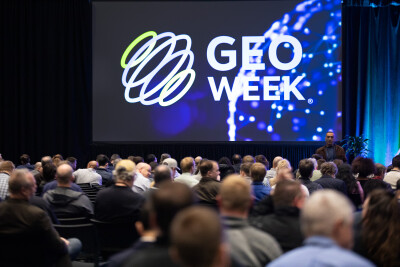

Anyone who has attended a geospatial conference knows the feeling: you're sitting in a session, the presenter shares a workflow or a challenge that hits close to home, and you want to raise your hand and say, "We ran into the same thing, here's what we tried." But the format doesn't leave room for that. The session ends, the speaker gets swarmed at the podium, and the moment passes.
That's exactly the gap Geo Week's new roundtable discussions are designed to fill. For the first time, the 2026 program includes a series of open, interactive roundtable sessions running across all three days of the event. These aren't panels, and they aren't presentations. They're structured conversations built around specific topics where attendees and exhibitors are the participants, not just the audience. No invitation is required, and every roundtable is open to anyone with a Geo Week badge.
The format reflects something the geospatial community has been asking for: more opportunities to engage directly with peers, compare experiences, and work through shared challenges in real time. Whether the topic is AI-driven workflows, mobile mapping tradeoffs, workforce development, or national standards adoption, these sessions are designed to go deeper than a typical conference talk allows, giving practitioners a space to speak candidly about what's working, what isn't, and where the industry needs to go next.
Here's a look at every roundtable on the schedule for Geo Week 2026, along with who should be in the room for each and what you stand to gain by attending.
From Data to Decisions: Geospatial Workflows in the Age of Automation and AI
Monday, Feb 16 | 2:00 - 3:30 PM MT | Bluebird Ballroom 2A
The geospatial data pipeline is being reshaped by automation and AI, and this roundtable digs into what that actually looks like in practice. Where is automation delivering real efficiency gains? How is AI-driven extraction pushing value beyond traditional visualization? What new decision-support capabilities are emerging?
Who should go: Geospatial data producers, solution providers, AEC and infrastructure professionals, public sector teams, and anyone building or managing automated and AI-enabled workflows.
Why attend: This isn't a high-level AI hype session. It's a working conversation about what's real, what's working, and what's next. You'll leave with practical takeaways and connections to peers tackling the same challenges.
Mobile Mapping in Practice
Monday, Feb 16 | 4:00 - 5:00 PM MT | Bluebird Ballroom 2A
Mobile mapping systems are getting smaller, more flexible, and more capable. This roundtable focuses on how those shifts play out in the field: where compact systems outperform larger setups, where high-end systems still win, and what tradeoffs practitioners navigate daily. Expect real talk about point cloud quality, accuracy, and how different approaches feed into GIS and digital twin environments.
Who should go: Surveyors, geospatial data producers, infrastructure and DOT professionals, AEC and engineering teams, and technical decision-makers evaluating mobile mapping solutions.
Why attend: The insights here come from people doing the work, not just selling the tools. It's a rare chance to compare notes on what's actually working in mobile mapping right now.
The Impact of Radiance Field Representations in the AEC and Geospatial Industries
Tuesday, Feb 17 | 11:00 AM - 12:30 PM MT | Bluebird Ballroom 2A
Neural Radiance Fields (NeRF) and Gaussian Splatting are no longer just research curiosities. This roundtable explores practical applications of these 3D representation methods in site documentation, as-built verification, digital twin creation, and asset management, while assessing their strengths and limitations compared to photogrammetry and laser scanning.
Who should go: AEC professionals, geospatial technologists, reality capture specialists, and anyone evaluating radiance field technologies. Whether you're just getting curious or already running pilots, this session meets you where you are.
Why attend: Radiance fields are evolving fast. The best way to understand their trajectory is to hear from peers testing them in the real world. Come ready to ask hard questions and share early results.
Building the Next Geospatial Workforce
Tuesday, Feb 17 | 2:00 - 3:30 PM MT | Bluebird Ballroom 2A
The geospatial workforce gap is real and growing. This roundtable brings educators, employers, and industry partners together for a candid conversation about closing it: aligning academic programs with real-world needs, engaging students earlier, and building partnerships that support recruiting and retaining the next generation.
Who should go: Educators in geomatics, surveying, GIS, and reality capture; employers and hiring managers; professional associations involved in workforce development; and anyone responsible for recruiting or developing early-career talent.
Why attend: Talking about the workforce shortage is easy. Doing something about it requires the right people in the same room. This roundtable moves from discussion to actionable strategies.
Advancing Open Standards for Horizontal Infrastructure
Tuesday, Feb 17 | 4:30 - 5:30 PM MT | Bluebird Ballroom 2A
Developing U.S. national standards for horizontal infrastructure using open-source workflows is a massive challenge. This roundtable gathers representatives from federal and state agencies, DOTs, contractors, and AEC design firms to discuss barriers limiting broader adoption of BuildingSMART USA open-source workflows.
Who should go: Federal and state agency representatives, DOT professionals, contractors, and AEC design firms involved in infrastructure delivery who care about interoperability and open standards.
Why attend: Standards work moves faster when the people affected are actively shaping them. This collaborative session focuses on alignment, interoperability, and real next steps.
The Next Generation of 3DEP: A Community Discussion
Wednesday, Feb 18 | 1:00 - 2:30 PM MT | Bluebird Ballroom 2A
The 3D Elevation Program (3DEP) is entering its next phase, and this roundtable is your chance to engage directly with thought leaders from government, industry, and academia. Bring your ideas and recommendations for how 3DEP can succeed going forward.
Who should go: Anyone with a stake in national elevation data: government agencies, private sector data producers, researchers, and end users who depend on 3DEP.
Why attend: How often do you get to sit across from the people shaping a national program and share your perspective? This is that opportunity.
NSRS Modernization and Professional Societies
Wednesday, Feb 18 | 10:30 AM - 12:00 PM MT | Bluebird Ballroom 2A
This roundtable opens with an introduction from Rachael Dempsey, National Ocean Service Deputy Assistant Administrator, followed by a look at how geospatial professional societies are preparing members for the Modernized NSRS transition. The session then moves to action with a hands-on self-assessment exercise led by ASPRS and NSPS NSRS Modernization Working Groups covering data, metadata, workflows, accuracy requirements, and pathways to adoption.
Who should go: Surveyors, geodesists, GIS professionals, and geospatial professional society members. If the coordinate reference system underpinning your work is changing, be here.
Why attend: The hands-on self-assessment gives you a concrete picture of what the transition means for your organization and what steps to take next. That kind of practical guidance is hard to find anywhere else.
Geo Week's new roundtable format is built on a simple idea: the best insights come from conversation, not a stage. Pick your sessions, come ready to talk, and we'll see you in Denver.

.jpg.small.400x400.jpg)