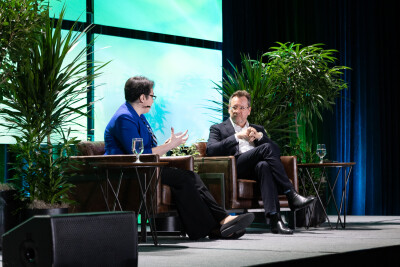

At the outset of the recent webinar “Ahead of the Curve: Emerging Ideas Redefining Geospatial,” Geo Week News Content Manager Carla Lauter explained that the goal of the event was “not to speculate wildly about the future, but to really understand how these innovations are underway and how we should be preparing for them.”
To that end, an experienced panel of geospatial professionals, including Dr. Qassim Abdullah, Vice President and Chief Scientist at Woolpert, Inc., Chancee Vincent, Geospatial Solutions Architect at NV5, and Ben Stocker, Senior Construction Technologist at Skender, engaged in a wide ranging conversation that touched on everything from the ways AI is transforming geospatial workflows to shifts within the geospatial workforce to changing data standards to the development of agentic AI. They discussed AI-driven automation, edge processing, new sensor capabilities, data interoperability, and more, and they explored ways that individuals working in the geospatial sector can get the most out new techniques and technologies.
Not surprisingly, the impact of AI on geospatial work was a critical topic during the webinar. Speaking broadly about AI, Abdullah asserted that the geospatial industry is in “a transformational moment.” He said that “AI is not the future of geospatial, it is already here” and that “its real value is not in replacing professionals—it is in elevating what the professional can accomplish.” Stocker and Vincent concurred and presented examples of how AI and related systems are already adding efficiency and accuracy to their projects.
Building on their discussion of AI, the panelists explored issues around geospatial standards like STACK and how they impact the effectiveness of geospatial AI. Vincent described STACK as “a clean, predictable way of organizing geospatial data sets,” and he explained how STACK and other approaches that are already here or upcoming “all solve the same underlying problem” around organizing and processing data. Vincent’s “hot take” on the topic was that “standards like STACK don’t just make agents possible, they’re what make agents usable at scale.”
Stocker explored the practical, real-world benefits and challenges of using AI and new standards in geospatial operations. He explained how new approaches are enabling geospatial professions to work with much more data on a given project, but he repeated the age-old adage of “garbage in, garbage out.” With this in mind, he said it was imperative to have “better inputs so we can have better outputs.”
To conclude the presentation, the panelists were asked how to stay current with new developments in technologies and workflows and how best to incorporate innovations into their workflows. Abdullah recommended that geospatial professionals should avail themselves of technical journals and publications, and take advantage of professional networks, platforms like LinkedIn, and events like the annual Geo Week conference. This way, he said, individuals can find out what their colleagues are talking about and gain insights into incorporating new innovations in their day-to-day work.