

At Trimble Dimensions, I had the opportunity to speak to someone who changed the way that I think about digital heritage preservation – in all the best ways. I was introduced to Sotaro Yoshikawa, the architect leading an ambitious preservation effort in Japan using new techniques and approaches for heritage conservation. His company, Yoshisho Architects Co., Ltd., have been using SketchUp and laser scanning technology to capture detailed point cloud data, and working to capture every detail of the impressive and sacred structures. The conversation confirmed that the firm is pioneering a unique form of cultural preservation, melding sophisticated 3D scanning with ancient wisdom about longevity.
This would have been a straightforward story about preserving as-builts, until Yoshikawa slipped a folded piece of rice paper out of a folder to show me. As the paper unfolded, he explained that one outcome of this massive effort is not just to have digitally archived sites like the Daihonzan Eiheiji Temple, but to also create tangible rice paper prints to live on as precise, physical blueprints that can survive the uncertain future of digital technology.
The Urgent Need: Climate and Fire Threats
Ancient wooden temples and shrines in Japan face constant existential threats from earthquakes, wind damage, floods, and most notably, fire. Eiheiji, the centuries-old Zen monastery in Fukui Prefecture founded in 1244, has already suffered eight major fires in its history.
The master carpenters leading the preservation team, including T&I Co., Ltd.’s Master Carpenters Sotaro Yoshikawa and Taku Ueno, are driven by recent tragedies. The 2019 fire that destroyed Shuri Castle (a World Heritage Site) highlighted the devastating effect of insufficient documentation, as its reconstruction is still taking significant time. In contrast, the reconstruction of the wooden roof of Notre-Dame Cathedral in Paris after its 2019 fire was greatly aided by the prior existence of precise point cloud data.
Beyond catastrophic fires, modern environmental concerns like increasing humidity and the risk of landslides are major concerns for these structures.
Technology in the Hands of the Carpenter
The innovative element of this Japanese preservation movement is that it is led by master builders, not just surveyors. The team leader, who began his career as a carpenter at age 20 and has over 25 years of experience in 3D CAD, emphasizes that the preservation philosophy hinges on capturing every minute detail.
The team utilizes high-resolution technology like lidar devices and photogrammetry. Specifically, they employ Trimble scanners, including the X7, X9, and X12, to measure the entire site in detail. Crucially, the master carpenters assess the building conditions themselves, identify key points to measure, and conduct surveys in difficult and dangerous areas, such as attics and crawl spaces. This is vital because the structural importance of traditional wooden buildings is often hidden in these unseen parts.
The team’s scanning process is built around a philosophy of precision, speed, and practical understanding of what truly matters in traditional wooden architecture. Instead of relying on photography—which cannot capture true dimensions—the master carpenters use laser scanners to obtain the exact measurements needed for faithful preservation. This level of detail allows them to notice subtle distortions, uneven settling, or structural shifts that would otherwise remain invisible. The point cloud data functions almost like a CT scan for the buildings, revealing the slightest irregularities that could signal future risk.
Because access to sacred sites is often limited, productivity is essential. The team frequently deploys two or even three scanners simultaneously to capture as much of the environment as possible in the time they’re given. Their deep familiarity with the buildings themselves, combined with the ability to navigate hazardous spaces like attics and crawl areas, ensures that nothing important is overlooked. This meticulous approach produces enormous datasets—Eiheiji’s Hatto Hall alone generated more than 2.1 billion points—forming a remarkably accurate digital twin of each structure.
The “Fishprint of a Building”: Why Paper Outlives Pixels
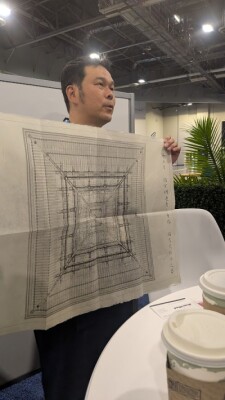
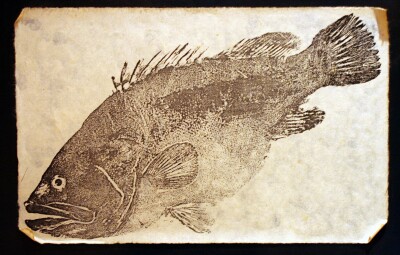
The real ingenuity of this project lies in the final output: translating complex 3D data into physical paper documents. This concept is referred to as the “fishprint of a building”.
This term draws on Gyotaku, the traditional Japanese method of fish printing, where a fisherman would apply ink to a fish and press paper onto it to create a perfect impression of the catch at that specific time. The print serves as a memorial of an ephemeral thing—the fish—that cannot be kept forever.
Similarly, these temple prints are a metaphor for permanence. The 3D data is fed into a computer to create drawings that represent the real size and real form of the temple. This process uses parallel projection to ensure the shape and dimensions are accurately preserved for future use.
The fundamental philosophy is pragmatic: addressing the uncertainty of the digital world. While we cannot know what computer or data format will be legible in 100 or 1,000 years, papers can exist for a thousand years. These physical documents contain all the necessary architectural size and material information, ensuring that future craftspeople can precisely renovate the structure, even if it is destroyed by fire or other disaster.
The Yoshikawa is passionate about sharing this preservation technology globally, intending to share this unique idea with other carpenters and vendors worldwide. He actively supports collaboration, even leading local groups to study and discuss SketchUp (a good tool for modeling in the Trimble ecosystem) and sharing user feedback with Trimble.
In this effort, the precision of modern scanning acts as the high-tech scribe, while the timeless rice paper acts as the enduring medium. It ensures that when data meets devotion, the architectural heritage is preserved, not just as a fragile memory, but as a sturdy, legible blueprint for future generations.


