

“What cannot be measured cannot be managed.”
This quote from Lord Kelvin, the renowned 19th-century British physicist and mathematician, was mentioned early on in the keynote kicking off day two of Geo Week 2026, and the message cut through the rest of the session. Burkhard Boeckem, CTO at Hexagon, was the featured speaker for this keynote, talking about the exciting future that lies ahead for the geospatial industry as the confluence of technologies and innovative spirit drives the industry to new levels. “Welcome to the age of intelligence,” he told the crowded room full of geospatial professionals.
Prior to looking ahead at the newest technologies that are driving this critical sector to new frontiers, though, Boeckem first looked back at the evolution of measurement, and how this concept of measurement has defined the great achievements of our past. The cubit, measured from the tip of the index finger to the elbow, was used by the ancient Egyptians in building the pyramids, structures that are still standing and creating wonder today. Furlongs, the distance an ox could plow without stopping, helped streamline agriculture at a time when it was the most critical industry on the planet. He talked about the development of the mile by Queen Elizabeth, and the creation of a meter, defined as one ten-millionth of the distance from the North Pole to the Equator.
That evolution, he noted, has brought us to where we are today, measuring all the way down to the micron and defining the success of some of the most important projects in the world, all the way from the world of AEC and surveying to putting man on the moon.
“Measurement is the silent force behind every breakthrough, from the phone in your pocket to the plane that brought you here,” Boeckem said.
From that past, he transitioned into where we are today and to where we are going, telling the crowd that we are evolving to a new stage, where measurement is being combined with intelligence. With the confluence of ever-improving reality capture technology, visualization being optimized through partnerships with leading companies like NVIDIA, and, of course, today’s seemingly infinite growth around artificial intelligence, the scope of this work fundamentally changed.
“Once measurements move from point to reality, something changes. We’re no longer just recording the world. We’re actually modeling it,” is how Boeckhem puts it.
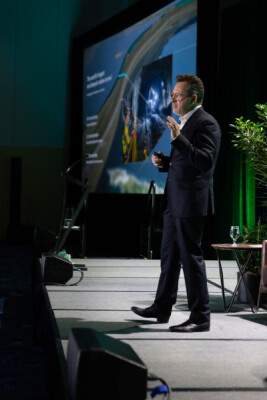
To emphasize just how much the world of geospatial work is changing, Boeckem ran through some of the most recent innovations across all types of data capture and visualization from Hexagon over the last couple of years. That includes the BLK2GO, their handheld SLAM scanning system, and products from IDS GeoRadar, and their TRK mobile mapping systems. Moving from the ground to the sky, he also introduced their brand new MultiMapper airborne mapping system, merging imaging and lidar sensors within a single system.
And finally, as none of this works without software and visualization, leading to their aforementioned partnership with NVIDIA. For that, they have connected HxDR, Hexagon’s data management platform, and NVIDIA’s Omniverse to create breathtaking, photorealistic visualizations of projects across verticals, some of which were showcased during the keynote.
Following Boeckem’s presentation, he was joined on the stage by Carla Lauter, Geo Week’s senior content manager, for a fireside chat focusing on what all of this innovation and change means for those who are out in the field and working on these kinds of projects every day. It’s one thing to talk about what the next few years will look like at a high level from a technology and innovation standpoint, but this chat honed in on the practical takeaways those in the industry need to know to best position themselves for this future.
To get the conversation started, Lauter brought things back down from a high-level view of the future of the industry to look at what this transformation into the “Age of Intelligence” practically means for attendees of Geo Week who are working in the field. Boeckem noted that the continued emergence of artificial intelligence is not a bad thing for the industry, but instead makes these professionals all the more important. The data collected by geospatial professionals, he said, helps “ground AI into reality.” He made clear that, of course, this is different from the large language models that are proliferating the consumer market.
In continuing the conversation around AI, Boeckem continued to emphasize the role that AI is going to play for this industry. He mentioned multiple times that these tools are not built to replace the workers in the industry right now, but rather to “augment” them.
“[AI is] augmenting our world,” he said, “taking out the boring, the tedious, the mundane tasks, and leaving us humans the exciting things, leaving enough space for our creativity.”
In fact, he said that people in the industry today should not be thinking about their roles any differently with the advent of AI. Instead, he said it was the exact opposite, because in order for these AI models to work correctly and maximize their value, they are going to rely on the accurate data that is and continues to be collected from the geospatial professionals in the field every day.
Staying open to the rapid change coming to the industry was another one of the major points brought forward by Boeckem throughout his presentation. Lauter asked during the conversation about what separates companies that transition into new systems successfully from those that do not. He noted that, by and large, it comes down to the people who are leading the company and ensuring that they have the vision for the future. On top of that, there is a level of patience that is needed for new technologies to return that value.
It was a good transition to how he closed things out, too, offering a word of advice for geospatial professionals. He said, to start, that for new people entering the industry, it is probably the most exciting space to be entering right now. And more broadly, for people looking to advance their careers and the industry, he had a concise but important piece of advice.
“Stay curious, and stay open to new technologies.”


