
Some of the most haunting discoveries aren’t found in monster houses or graveyards but in forgotten chapters of history. Lidar has helped reveal lost cities, traces of ancient conflicts, and remnants of civilizations once hidden from view. So grab your apple cider, heat up that pumpkin pie, and read on.
“Ghost” cities in the jungle
In southern Mexico, researchers used lidar to detect the remains of a vast ancient Maya city known today as Valeriana. The city was discovered in 2013 and only recently named in October 2024. The data revealed thousands of structures across more than forty square miles, including pyramids, sports fields, causeways, and amphitheatres. Although Calakmul continues to be the largest discovered Maya site, Valeriana is the second. For centuries, much of this network remained hidden beneath dense rainforest, largely unnoticed from the ground.
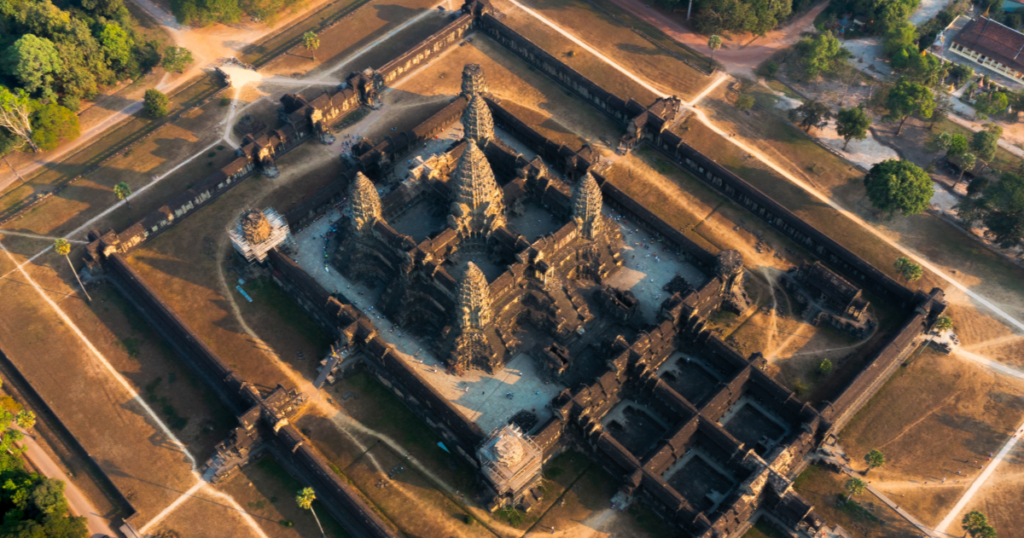
Deep in the Cambodian jungle lies the Angkor Wat temple, a symbol of Cambodia’s national identity and heritage and a testament to the advanced workings of the Khmer Empire. In 2013, lidar surveys showed that the Angkor Wat temple was part of a much larger and more complex urban network. Beneath the trees, imaging revealed canals, roads, and water systems extending far beyond the temples, suggesting that what appeared to be isolated monuments were part of a much larger urban landscape.
Traces of conflict beneath quiet landscapes
Geospatial mapping has also revealed evidence of past human activity, including sites tied to ancient conflict that history has nearly erased. In parts of Europe, aerial scans have revealed Roman forts, defensive walls, and siege works buried beneath farmland and forest. Falerii Novi was a 75-acre Roman city that was mapped using lidar that revealed an intricate network of streets, temples, and monuments. At the Vulci archaeological site, researchers were able to uncover an ancient Etruscan-Roman settlement. Scans have also been able to detail the Colosseum’s underground labyrinth to a precision never before seen. To the untrained eye, all these features appear as faint ridges or subtle changes in elevation. When viewed through lidar, these subtle patterns hint at long-forgotten structures and the civilizations that built them.
When discovery turns dangerous
Not every new archaeological discovery guarantees preservation. As lidar exposes ancient temples, tombs, and artifacts, it can also make them vulnerable to looting and destruction. In parts of Central America, newly uncovered Mayan sites have been damaged before researchers could study them. An El Peru-Waka’ stela fragment was cut with saws and removed between 1966 and 1971 after its discovery. Cancuen is a major site that has been subjected to looting events from the 1960s into the 2000s. Most notably, a ballcourt marker from the site was stolen in 2003. The same technology that helps us study and preserve history can, without careful management of sensitive data, put cultural heritage at risk. Responsible stewardship and collaboration between scientists and local communities are essential to protect what’s uncovered.
Ghosts beneath familiar ground
Some of these discoveries have happened much closer to home in the US. In the forests of New England, laser mapping has revealed the outlines of old roads and colonial homesteads that disappeared centuries ago. The wooded hills and dense forest have long concealed traces of past human activity. However, beneath thick vegetation lie the traces of early settlements that are evidence of lives and stories that would otherwise remain lost to time.
Why these discoveries matter
Geospatial technology has changed how we study and safeguard our past. By revealing what lies beneath the surface, lidar helps researchers identify and protect cultural sites before they’re lost to erosion, destruction, or decay. It also highlights the need for skilled professionals who can interpret this data and translate it into meaningful insight.
This Halloween, as we celebrate stories of ghosts and mystery, remember that Earth holds real stories of the past. Thanks to lidar and 3D imaging, researchers continue to piece together the complex story of human history. The most haunting discoveries may not be supernatural at all. They are scientific, and they are still unfolding.