

Not long ago, choosing a reality capture method was a binary decision: you either deployed a terrestrial laser scanner for millimeter accuracy, or you sent a drone up for photogrammetry when speed and coverage mattered more than precision. That trade-off shaped project planning, equipment budgets, and crew training for years.
Today, a growing number of firms across architecture, engineering, construction, and public infrastructure are no longer choosing between methods, they’re combining them. The hybrid workflow has arrived, and with it comes a new set of best practices, tools, and organizational skills that the industry is still actively learning.
Why Hybrids Now?
Three converging forces have made hybrid workflows viable at scale. First, hardware costs have fallen dramatically, a capable mobile lidar backpack that would have cost $150,000 in 2019 can now be leased or purchased at a fraction of that. Second, software platforms like Leica Cyclone, Autodesk ReCap, and emerging AI-driven tools now natively support multi-source point cloud fusion, eliminating the painful manual alignment work that once made combining datasets impractical. Third, client expectations have shifted: owners want digital twins that are both accurate and comprehensive, and no single capture method delivers both without compromise.
The Core Hybrid Configurations
While every project is different, three hybrid pairings have emerged as the most common in the field:
Terrestrial + Aerial
Ground-based lidar for interior detail and facade accuracy; drone photogrammetry for rooflines and large-area coverage.
Mobile + Static
Walk-through mobile scanning for corridors and large floors; static scans for complex structural connections requiring precision.
Lidar + Photogrammetry
Fusing point cloud geometry from lidar with photogrammetric texture and color for rich, deliverable-ready digital twins.
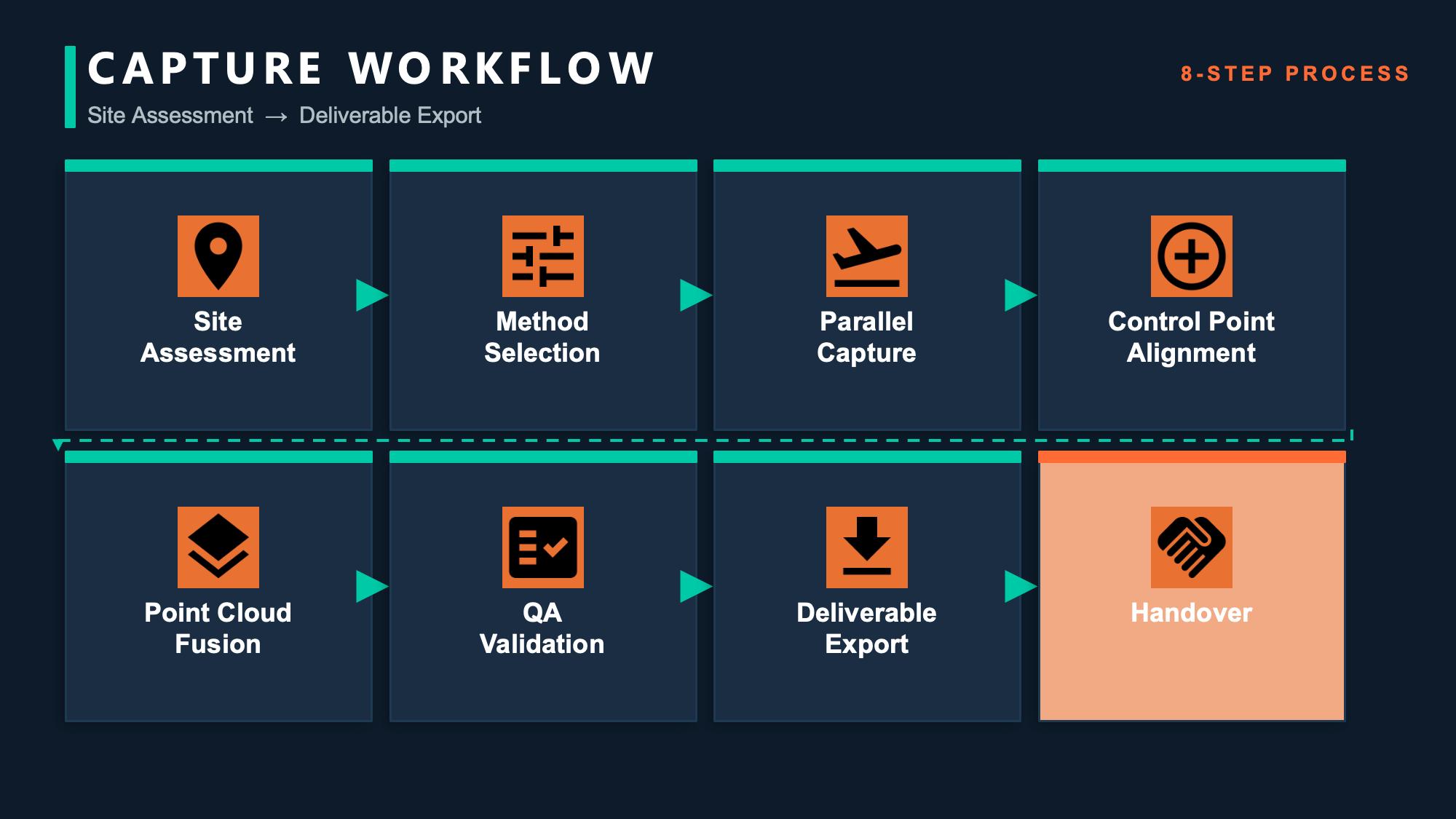
A Typical Hybrid Pipeline
In practice, hybrid workflows follow a common sequence, though the specifics vary by project scale and deliverable requirements:
The Emerging Role of AI in Fusion
Perhaps the most significant recent development is the use of machine learning to automate the alignment and classification steps that once required expert manual work. Tools like Leica’s HxMap pipeline and several newer cloud-based platforms now use AI to automatically detect and match corresponding features across lidar and photogrammetric datasets, dramatically reducing the time between capture and a usable, fused point cloud.
This doesn’t eliminate the need for skilled operators, but it does shift the skill requirements. Expertise is increasingly less about operating the hardware and more about understanding how to structure a capture campaign so that AI-assisted processing can work effectively. Which means understanding sensor overlaps, lighting conditions, and control point geometry.
What This Means for Teams
Organizations adopting hybrid workflows are discovering that the organizational changes are at least as significant as the technical ones. Siloed teams, one group that “does the scanning” and another that “does the processing”, tend to struggle. The most effective hybrid workflows are run by teams where capture specialists understand processing constraints and vice versa, and where clear data handoff protocols exist from day one.
Looking Ahead
The trajectory is clear: hybrid reality capture is moving from a niche capability practiced by early adopters to an expected baseline on complex projects. The firms investing now in cross-trained staff, integrated software environments, and repeatable hybrid workflows will have a structural advantage as clients continue to raise the bar on what a “complete” digital deliverable looks like.
The technology will keep evolving, sensor fusion at the hardware level, real-time processing on mobile devices, and tighter BIM integration are all on the near horizon. However, the enduring competitive differentiator will be the same thing it has always been: the expertise to know which approach to use, when, and in what combination.


