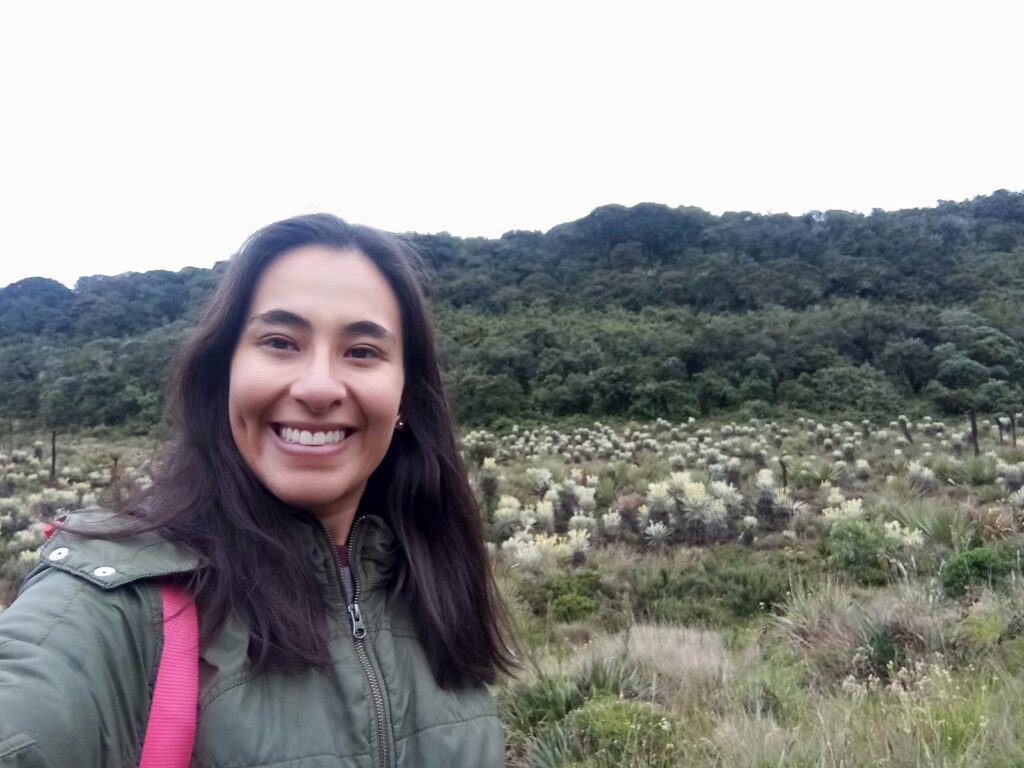
Paulina Vergara Buitrago grew up in Colombia, surrounded by the Andean mountains that now sit at the center of her life’s work. Today, as a researcher at the University of Minnesota Twin Cities, she is mapping two decades of land cover change in one of Colombia’s most ecologically significant highland regions. But for Paulina, the satellite data and GIS maps are only half the story.
“It’s the human that brings me here today,” she said at Geo Week, the geospatial industry’s premier annual conference, where she was recognized with the Geo Empower scholarship.
Potatoes, Páramos, and the People Who Know Best
Paulina’s research is rooted in the central Andean region of Colombia, a high-altitude ecosystem known as the páramo, where farming communities have cultivated potato crops for generations alongside onions, carrots, and other cold-weather vegetables. Using GIS tools, she is tracking how the landscape has shifted over 20 years. But she is equally committed to understanding why those changes happened, and that means sitting down with the farmers themselves.
“You can have a really nice idea for a restoration or reforestation project, but without the community, the project is not going to be effective,” she explained. “It’s people – the community who lives in this place – who can help me understand what is behind those changes.”
What she found in the field surprised even her. Farmers carry a deep, generational knowledge of their land that no remote sensing dataset can capture. They know why the soil quality has shifted. They know that rotating crops too quickly depletes the land, but they also know that if they want to produce enough to survive, they often have no choice.
“They recognize that they live in a strategic ecosystem,” Paulina said. “They understand this place is important because it provides water resources and everything they need day by day. But there are no policies that promote more sustainable agriculture.”
Without market infrastructure to support eco-friendly practices at scale, farmers remain locked into high-input, technical agriculture, not because they don’t know better, but because the economic conditions leave them little room to do otherwise.
Listening Without Rewriting
Paulina is deliberate about how she translates what she hears into research. She pushes back against the common academic habit of collecting community voices and then filtering them through a researcher’s assumptions and framing.
“When you go to work with communities, you only take data and then you write your story with your bias and assumptions,” she said. “I want the words in my documents to be the words of the people I work with. I translate the history, but I don’t change the narrative.”
She describes her role as that of an editor – present, but not dominant. The community’s voice remains the lead author.
This philosophy was shaped early in her career, before she even knew she would go into research. As a young environmental engineer doing fieldwork, she arrived in a rural community carrying academic surveys and technical terminology. The response was immediate: What does that mean? What is that?
“I learned that you need to be humble and reduce one level when you speak with different communities,” she said. “That experience changed my mind, and it helped me improve my communication skills across different levels.”
Recognition Across Borders
Winning the Geo Empower scholarship is, for Paulina, less about personal recognition and more about visibility for the places and people she represents. She hopes the award helps put the Colombian páramo on the map, figuratively, not just literally.
“So few people know about this environment,” she said. “I want to continue explaining the world around our own community, in my own country and in this country.”
She also sees academia as a vehicle for connection: between researchers and farmers, between Colombia and the United States, between local knowledge and global science. “When you work in an office, you can be doing nice things, but it stays in the office. In academia, because of the networks you build, your work is expressed in the world.”
Her next goal is to close the loop and to take her research findings back to the farming communities themselves, not just to conference rooms and journal submissions.
“How can we create a space to go from the university to the farm and share results with the farmers?” she asked. It’s a question, she says, that every researcher working with communities should be asking