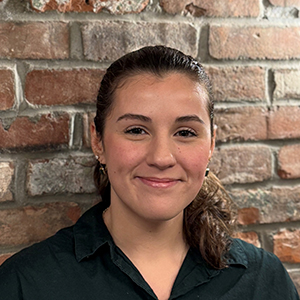

Throughout her career, Dr. Julia Wagmann has been driven by a desire to grow. Her academic foundation in geography marked the starting point of her work where she focused on building a strong technical foundation with skills in programming and data handling that equipped her to work within Europe’s evolving Earth observation landscape. As Copernicus opened the door to an era of massive satellite data availability, she developed experience in understanding and managing these emerging datasets
Drawing on her experiences working with major European data providers and years as a consultant, Wagemann observed a recurring challenge among users: the need for more accessible, practical ways to work with geospatial data. This insight led her to found thriveGEO, a training company dedicated to delivering hands-on, skills-based learning for professionals navigating geospatial tools and applications.
Her drive to foster growth, both personally and within the wider community, led her to take on additional initiatives. In 2019, she co-founded Women+ in Geospatial, with a mission to inspire, unite, and empower women and other underrepresented genders in the geospatial field to become leaders and changemakers. This experience connected her with new networks and perspectives that further shaped her professional and personal development and encouraged the development of others. Today, Wagemann’s work reflects a blend of technical expertise, user-centered thinking, and her dedication to empowering others in the geospatial community.
In a conversation with Geo Week News, Wagemann reflects on how her experiences have shaped her approach to geospatial training and her perspective on the growing value of accessible learning in a rapidly changing industry. She talks about the gaps that still exist for many professionals trying to make sense of expanding datasets and new tools, and noting that for many in the geospatial world, hands-on experience and curiosity play a significant role alongside formal academic training.
Your PhD research, “Big Earth data towards a better understanding of users and their training needs,” explored how professionals interact with geospatial tools. From that work, what do you see as the biggest current skill gap in the geospatial workforce, and how is thriveGEO working to close that gap?
Dr. Julia Wagemann
My PhD research started about six years ago. The motivation for the PhD was that I worked at European data providers, and the question was always, “Who is actually using the data? Who are our users?”
In my role at the European Data Centre, when I asked 10 different people who our user was, I got 10 different responses. This motivated me to understand the roles, the professions, and the types of people who are using large volumes of Earth observation data, and if they use the data, how they are going to use it. I wanted to know what tool sets they use and what application areas, workflows, types of data, and programming languages they utilize.
This research was about shedding more light on the different types of users of Earth observation and satellite data. At that time, because of the large volumes of data, it was the start of cloud computing. This created a relevance for people working with geospatial data to get a more technical understanding of cloud processing, including tools for administering workflows in the cloud.
I would say this is still ongoing; it is a big shift. In the last five years, there have been a lot of developments regarding cloud-native geospatial, and this will be the future. We have cloud-optimized data formats now, and this is how geospatial workflows will be conducted—in a cloud-optimized way. This is definitely one upskilling area for geospatial professionals already in the profession. This shift also needs to come to the education sector and universities, because accessing data, downloading it, and then processing it on your local machine is no longer viable, specifically when we talk about large volumes of data.
Another critical skill set that has become more important in the last two years is associated with AI. The question is: how does AI affect the geospatial industry and specifically how geospatial professionals work? I see two areas where a different type of skill set will be required:
-
Integrating AI tools that are evolving into your toolset. Geospatial professionals will interact with agents, and they need to learn how to interact with and leverage these agents in the best way possible.
-
An area that is a bit underrated is focusing on impact and context. Because AI accelerates how we conduct processes and workflows, we now have much more time to go further down the value chain and think about the impact and the context of how we can use geospatial data and apply it in different industries. In the past years, professionals often didn’t have time for this because it was so complex just to bring all the different data sets together; they were just happy they finally had their map of a specific variable. This ability to ask the right questions in different areas will definitely increase. The more you know about how geospatial data and information can be used in different contexts and in different industries, the more valuable you will be, as these will be the relevant skills.
With thriveGEO, we see that the training and learning space for Earth observation in geospatial is diverse. People either learn it at the university level (majoring in geography, forestry, or environmental sciences and picking up some tools), or we see data scientists, not necessarily knowing anything about geospatial, also entering the space. We develop trainings that provide an agnostic overview of relevant tools and skills that people working with geospatial data need, not only in a scientific context but also in an applied industry focus. We work a lot with corporations and companies directly to assess the skills of their teams and develop specific upskilling trainings for them on cloud-native geospatial. We are also developing a course on geospatial fundamentals because we see many professionals entering the space without the necessary geospatial background.
How are specialized cloud platforms and collaborative tools like Jupyter Notebooks changing what’s expected of entry-level geospatial professionals?
Dr. Julia Wagemann
It’s a good question. The landscape of the cloud and the different tools available is quite fragmented and diverse, which will probably remain the same. This diversity is good because different platforms or tools serve different communities.
As an entry-level geospatial professional, I would recommend definitely getting a good understanding of the tools and platforms that exist and really understanding their purpose and the community they serve.
Google Earth Engine, for example, was a game changer when it started around 2012. It was the first platform that truly understood that just dropping terabytes of data to a cloud bucket was not working. They understood that you need to take it further and make it easily accessible with an interface. People needed to learn to code, but in a layered, easier way. They were able to develop a huge community that serves a specific need; I think it helped thousands of PhD students with their studies.
The barriers to actually getting started are getting lower and lower, especially with tools like AI. It is very easy to get started. You can explore, prototype a lot, and test many things. Five or ten years ago, you needed to install software or have access to it. This has changed a lot and will just become easier.
But at the same time, because it lowers the entry-level barriers, it is still important that you continue to critically think. For example, Google Earth Engine allows you to bring together a lot of data sets and create nice workflows using large volumes of data. But you still need to understand and validate what is coming out of your workflow. This critical thinking—asking, “Does it make sense what I see here? Is my result expected?” will become increasingly important, especially with AI.
As a co-founder and co-director of Women Plus and Geospatial, you’ve championed diversity and inclusion in the field. Why is gender diversity important for driving innovation and long-term success in the geospatial workforce?
Dr. Julia Wagemann
Studies, not only for geospatial but overall, show that diverse teams perform better. We all have different backgrounds and stories, and we approach topics and problems differently. The more diverse your team is, the better the ideas that come out of it.
We push this because the geospatial industry is already a niche, and we have a big workforce gap that is getting more concerning in the next year. Companies are looking for talent, but if we are not welcoming to half of the talent pool, then that is a problem. As a geospatial industry, even though we are niche, we cannot afford to let people go because they are frustrated. We have to make every effort possible to ensure people stay in their jobs in the industry, remain motivated, and have an opportunity to develop professionally and personally and leverage their expertise.
In the end, this collective expertise and innovation is what our industry is made of, and it is important to move forward.
Abigail Hart
Do you see any barriers to entry specific to the geospatial sector?
Dr. Julia Wagemann
It probably has different factors. I think it’s overall related to the societal setup that women find it harder to go back to work after they have kids, or they lose their job. Or they were looking for a promotion, but male colleagues or other colleagues got promoted, leading to frustration. I wouldn’t say these are specific barriers only for geospatial because the same reasons probably apply overall. However, I would say this is heightened because we are so niche.
A lot of discussions I’ve had point to the fact that it is actually not so easy to enter the geospatial field if you are not trained in geospatial, because spatial is special on many levels. This is probably what is unique to the geospatial industry: it is not so easy to just transfer your skills and then apply them to geospatial, because you always have to have this geospatial understanding and these fundamental concepts. You either need to learn these when you start or when you enter the industry, or it will be difficult to actually do your job.
Abigail Hart
How does thriveGEO, as a company, help lower those barriers for women and non-binary people with training tools? Do you think there are other ways that we as an industry can help encourage more women or other diverse participants to join the field?
Dr. Julia Wagemann
To make it attractive so that women enter and stay, a collective effort is needed. Networks and communities like Women+ in Geospatial are crucial just to come together and showcase that women and gender-diverse people exist, and we want to work and be motivated. There is talent, despite what we hear from a lot of companies that it is “difficult for them to find diverse applicants and build a diverse team.” There are a lot of opportunities to bring hiring companies and communities like Women+ in Geospatial together to support companies in building better diverse teams.
With thriveGEO, it’s also important to showcase women in their work. We actually don’t have the experience of being short of women applicants when we hire; compared to others, we have an increased rate of women applicants. This is probably because my co-founder and I are also strongly involved in Women+ in Geospatial. We don’t try with thriveGEO to tackle or solve the overall problem, but we can at least contribute. We have women in our team—at the moment we are only women—and we can also just showcase what it’s like working with a women-only team, even though it is not our company policy.
Over the past decade, you’ve worn many hats as an independent consultant, educator, and community builder. Given this experience, what advice would you share with geospatial professionals striving to continuously upskill and stay relevant in such a fast-evolving industry?
Dr. Julia Wagemann
To survive in any industry, but especially in geospatial because it is changing so fast, you really have to be continuously upskilling yourself.
This can be with formal training or by being part of different communities. You need to understand the current discussions, the latest tools, the latest developments, and the bottlenecks. Often, open-source communities drive standards or developments because they are trying to solve problems. It is important to understand or have a higher-level overview of the current challenges that need to be solved, which ultimately influence where the road is going.
There is no one answer or solution. What served me very well is being engaged with different communities, being actively engaged in open-source developments, contributing, and giving back. Also, continue to be curious. Once you know the latest tools that are being used, try them out, explore, and see what you can do. Maintaining this curiosity will definitely bring you forward.
Through initiatives like Notebooks Now and your role with the Expert Advisory Group for GEOSS, you’ve helped shape international standards. How do community-led and global collaborations help define the technical and ethical standards that will guide the next generation of geospatial professionals?
Dr. Julia Wagemann
That’s a very good and relevant question. The geospatial industry probably wasn’t the best at agreeing on standards quickly, which is why the landscape is fragmented, and we have different data formats, specifications, and standard bodies. Agreement was always a very long process until a format became a standard.
However, recently, related to cloud-native geospatial, there was the development of the Spatiotemporal Asset Catalog (STAC), which is a way to catalog data to access data from the cloud. This was the fastest uptake of community effort where the entire community agreed very fast on the principal framework or definition of the standard. Within two or three years, STAC has become an official OGC (Open Geospatial Consortium) standard.
It is important when talking about standards that the global community is involved and that there is a global uptake. Geospatial professionals already spend a lot of time trying out new tools and realizing they are not maintained, not used, or that the standard has a new version. The community values a set of core packages and core standards where everyone knows, “OK, this is the way it is done, and this is the best practice.” This is very relevant and important because we work with geospatial data that does not have any boundaries.
Having a unique and harmonized approach is crucial.
What recent breakthroughs in geospatial technology are most underappreciated now but will have the biggest impact in five years?
Dr. Julia Wagemann
AI will have an impact in the next five years, though it is probably not underrated. There was a report from Microsoft that suggested 40 professions would be eliminated through AI, and geographer was one of them. A counter article from someone at Esri challenged that opinion, and I agree that AI doesn’t eliminate professions; rather, it shifts them.
This shift, which I think is more underrated, is that geospatial professionals will need a lot of contextual information from different industries as part of their tool set. You will start from where the problem is and then work backward, applying your technical and data skills to find solutions. At the moment, it is often about applying technical skills to create a map, and then many organizations often don’t know what to do with the map (e.g., an NDVI map). I think starting from asking the difficult questions and then working backward will become increasingly important in the next five years.


