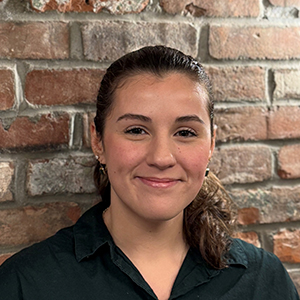

For some geospatial professionals, career growth extends beyond learning new tools to include communicating their expertise to those who can act on it. In a Geo Week News interview, we chatted with Izabela Miller on programs she’s designed to help professionals grow and translate complicated data to decision makers. Izabela Miller is a GIS and IT leader with experience spanning hands-on technical work, organizational strategy, and executive collaboration. Over the course of her career from intern to IT Director, she has worked across roles that required not only deep technical expertise, but the ability to translate geospatial data into digestible content that decision-makers can understand and act on. She is also the author of a leadership framework focused on clarity, systems, and stewardship, developed through years of working with GIS and IT teams navigating growth and change.
At Geo Week, Miller is a featured participant in the Women in Geospatial Meet-Up, where she brings a perspective shaped by both technical leadership and program development for emerging and established leaders. In this Q&A, she reflects on key moments that reshaped how she approaches leadership, including the shift from being a technical problem-solver to designing systems that support more effective decision-making. She also shares insights from her book on building lightweight governance, redefining the role of GIS within organizations, and creating space for purpose-driven leadership in technical environments. Read more below!
You have described the move from technical expert to leader as one of the hardest transitions of your career. Looking back at your journey from intern to IT Director, what was the most empowering realization or breakthrough that helped you find your authentic voice as a leader?
The move from technical expert to leader was hard because nobody tells you that your old success formula stops working. I was promoted because I could fix things fast and figure out complex problems. Suddenly, my job was people, politics, budgets, and conversations with executives who did not speak my language. The most empowering realization for me was this: leadership in GIS and/or IT is not about having all the answers – it is about designing the conditions for better decisions. Once I understood that, everything shifted. I stopped judging myself by how many fires I could personally put out and started asking different questions: Does my team know what matters most this quarter? Do we have a clear way for requests to come in? Are executives seeing the impact of our work in their language, not mine? That shift also helped me find my authentic voice. I did not have to become a different person to lead. I could bring my curiosity, my empathy, and even my introversion to the table – as long as I was willing to be honest about what was working, what was not, and what we needed to change in the system.
Early in your career as an analyst, you recognized that technology had untapped potential and saw exciting opportunities. What was the specific moment or project that inspired you to expand from “doing the work” to “leading the strategy”?
There was a very specific turning point for me. Early in my career, I kept seeing the same pattern: incredibly powerful technology sitting underused, and GIS being treated as a nice-to-have map service instead of a strategic asset. I could feel what was possible – but I could not yet show it in a way executives could act on. A key moment came when I was exposed to a maturity model for GIS strategy. For the first time, I had a way to measure where we were, not just where I wanted us to go. I brought that back to my organization, sat down with my CIO, and instead of saying, “I have a vision,” I could say, “Here is our current state, here is what is at risk if we stay here, and here is a realistic path forward.” That experience taught me that “strategy” is not a mysterious executive skill. It is the discipline of connecting vision to reality – with evidence, language, and timeframes that leaders can respond to. From that point on, I knew I could not stay in the role of “just doing the work.” I wanted to help shape the roadmap.
A central theme of your book is evolving from being “the map person” to a strategic partner. For those who are eager to make this shift, what is the first step in transforming their role from “heroic doer” to “system designer”?
The very first step is an identity shift you make with yourself, before anyone else believes it. Stop describing your job as “I make maps” or “I support GIS.” Start describing it as “I help this organization make better decisions with location-based information.”
It sounds simple, but the words you use change what you notice and how you show up. Practically, I encourage people to run one 90-day experiment where they act like a system designer, not just a heroic doer. For 90 days, pay attention to how work enters your world. Where do requests come from? Which ones actually move the needle for your organization? Where are you doing hidden rework because there is no clear process? Then, instead of quietly absorbing all of that, propose one small change: a clearer intake path, a simple prioritization conversation with your sponsor, or a short update to executives that ties your work directly to their goals. You do not have to wait for a new title to start behaving like a strategic partner. You start by changing how you see your role and by designing one piece of the system around you to work a little better.
Your framework focuses on Clarity, Systems, and Stewardship. Why do you believe building lightweight governance and service catalogs is such a powerful multiplier for a GIS leader’s success and impact?
Lightweight governance and a clear service catalog do not sound exciting at first – but they are one of the biggest multipliers of a GIS leader’s impact. Without them, everything feels personal. Every request is a favor. Every “no” feels like a rejection. Your team lives in reaction mode, and executives have no clear way to see what you actually do. A simple service catalog changes that. It tells the organization: here is what we offer, here is what it takes to deliver it, and here is how it supports our shared goals. Governance adds the “how” and the “who”: who owns this data or capability, how decisions get made, and how often you review what is working.
When those pieces are in place, several things happen at once:
– You reduce rework and surprises;
– You can say “yes”, “no”, or “not yet” based on agreed priorities, not emotion; and
– Executives can finally see patterns in demand and invest accordingly.
For GIS leaders, this is freedom. It frees you from being the bottleneck and allows you to spend more time on strategy, mentorship, and cross-department wins – the work only you can do.
You are featured in the Women in Geospatial Meet-Up at Geo Week. Based on your experience creating custom leadership development programs, what opportunities do you see for women in this field to lead with purpose and make their unique impact in technical terrain?
Women in geospatial are often navigating two demanding terrains at once: highly technical environments and complex human dynamics. That combination creates a powerful opportunity. In the leadership programs I design, I see women who are deeply skilled technically and also carrying unspoken responsibilities – mentoring others, smoothing conflict, translating between teams. Those “soft” contributions are actually strategic assets. They are the foundation of trust, collaboration, and long-term adoption of any system. The opportunity is to stop treating those instincts as invisible extra work and start naming them as leadership.
That can look like:
– Claiming responsibility for the bigger picture – not just your tasks, but how your work influences other departments;
– Asking for sponsorship, not just approval – “Will you champion this with me?” rather than “Is this OK?”; or
– Building peer circles with other women in technical roles where you can be honest, share tactics, and remind each other you are not alone.
Leading with purpose does not mean becoming louder or more like someone else’s idea of a leader. It means bringing your full intelligence – technical and relational – into the room and trusting that the way you see things is exactly what the field needs.
Lastly, what are you most looking forward to during your first Geo Week experience, and what do you hope to take away?
This is my first Geo Week, and I am genuinely excited to listen and support Geo Week and Women in Geospatial in any way I can! I have spent the last few months interviewing GIS and IT leaders about what is really happening behind the scenes – the wins, the frustrations, the experiments that worked, and the ones that did not. Geo Week is a rare chance to hear those stories live, in hallways and sessions, across industries. I am especially looking forward to the Women in Geospatial Meet-Up. Any time you bring together people who are leading in technical terrain and give them permission to talk about the human side of that work, something important happens. My hope is to leave with a deeper understanding of what leaders are wrestling with right now and where they feel hopeful. On a personal level, I am looking forward to testing the ideas from my book against reality: hearing where the framework of clarity, systems, and stewardship resonates, and where people need more support. I want to walk away with new questions, new collaborators, and a renewed sense of why this work matters so much for our organizations and for the communities we serve.
These themes will be covered in more detail in our Women in Geospatial Meet and Greet and across the Geo Week conference program. Ready to join the conversation?


