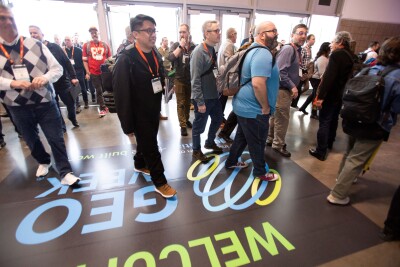

There's a particular moment that happens at many conferences: you're standing in line for coffee or lunch, scrolling through your phone, when someone next to you mentions a project that sounds remarkably similar to the challenge you've been wrestling with for months. By the time you look up, they're gone, lost in a sea of badges and booth displays.
Networking at technical conferences can often feel full of connections that slip away because we're not quite sure how to bridge the gap between "standing near someone interesting" and "having a meaningful conversation." At Geo Week, where discussions dive deep into specialized workflows, lidar processing pipelines, and the nuances of coordinate systems, that gap can feel even wider.
However, networking doesn't have to be a high-pressure game of collecting business cards or forcing conversations with strangers. With some intentional preparation and a shift in perspective, Geo Week can become a place where professional relationships form naturally and where technical curiosity leads to genuine exchanges that extend well beyond the conference hall. Below, we have five tips to help bridge the gap.
1. Research and Plan Ahead
The most productive networking often happens before you arrive at the venue. Geo Week's schedule is dense with sessions, demonstrations, and exhibitors, which means wandering without direction might leave you overwhelmed.
Start by reviewing the speaker lineup and session descriptions in our conference program. When you find a presentation that addresses a problem you're working on or introduces a methodology you've been curious about, that's your signal. These aren't just sessions to attend; they're potential conversation anchors. Consider reaching out to the presenter beforehand with a brief introduction and a genuine question about their work. Many speakers appreciate the engagement and may be open to meeting briefly during the event.
Equally important is clarifying your own goals. Are you looking to learn about a specific application area? Exploring career transitions? Trying to understand how other organizations handle data interoperability? Knowing what you're seeking helps you recognize the right conversations when they appear and gives you permission to skip the ones that don't align.
2. Practice Your Introduction and Limit Jargon
You'll introduce yourself dozens of times at Geo Week, and having a clear, 30-second version ready makes those moments significantly less awkward. The key is focusing on the problems you solve rather than the tools you use.
"I work in lidar classification for corridor projects" is accurate but abstract. I help transportation departments turn scan data into construction-ready models" tells a clearer story. The geospatial field is filled with specialists using different platforms and methods, which means jargon that's second nature to you might be meaningless to someone working two booths away.
Emphasize transferable skills like data management, systems integration, or stakeholder communication. These reveal your broader value and often resonate more deeply than a list of software proficiencies. People remember professionals who can explain complex work clearly.
3. Use Exhibitor Booths and Sessions as Conversation Starters
Sessions and the exhibitor hall aren't just information-gathering opportunities; they're structured environments where networking happens organically.
Asking a thoughtful question after a presentation does more than acknowledge the speaker's work. It makes you visible to other attendees who might be thinking about similar challenges. Often, someone will approach you afterward: "I was wondering the same thing; how are you handling that on your projects?" These spontaneous conversations can be more valuable than a dozen planned introductions.
Exhibitor booths can give you a clear reason to engage: learning about a product, understanding a workflow, or seeing how a tool addresses a specific challenge you're facing. The professionals staffing these booths know their organizations' work intimately and are often happy to connect you with colleagues who handle similar applications. These interactions frequently lead to follow-up conversations that extend beyond the show floor.
4. Stay Engaged and Approachable
Some of the best networking happens in the margins while you’re waiting for a session to start, grabbing lunch, or standing in the registration line. But only if you're actually present.
Putting your phone away while waiting signals that you're open to conversation. Eye contact and a simple greeting can be the difference between standing silently next to someone interesting and discovering a potential collaborator. The challenge is breaking the habit of treating downtime as a chance to catch up on emails rather than an opportunity to engage with the people around you.
Balance matters too. Not every conversation needs to be focused on work. Asking someone what sessions they've found most useful or what brought them to Geo Week this year can lead naturally into deeper discussions about their work. Informal settings like coffee breaks, evening receptions, and shared meals can often create the space for relationships to move from transactional exchanges to genuine connections. People remember conversations where they felt heard, not just pitches where they were talked at.
5. Follow Up After the Event
The conference ends, you fly home, and those business cards sit in your bag for weeks. This is where most networking efforts quietly die.
Following up doesn't need to be elaborate, but it does need to happen. Within a few days, send a brief LinkedIn request or email that references something specific from your conversation. "It was great talking with you about drone photogrammetry workflows, I'd be interested to hear how that project in Nevada progresses" is far more effective than a generic connection request.
Make a quick note about where you met each person and what you discussed while it's still fresh. These details become invaluable when you're trying to reconnect weeks or months later. Occasional follow-ups like sharing a relevant article, commenting on a post, reaching out when you see their company mentioned, help to maintain connections over time. The goal isn't constant contact; it's keeping the relationship alive so that when the right opportunity or question arises, the connection is already established.
The Long View
Networking at Geo Week doesn't have to feel like an anxiety-producing performance. Approaching it with preparation, clear communication, and genuine curiosity transforms it from an obligation into an opportunity to find community in the geospatial industry.
The relationships that matter most often start with small moments: a question after a session, a conversation at a booth, a shared frustration about data interoperability. What turns those moments into lasting professional connections isn't aggressive follow-up or perfectly crafted elevator pitches. It's showing up with intention (even if you stumble on the words), listening more than you talk, and staying engaged long after you've returned home.
The geospatial industry is built on connections - between datasets, between systems, and between the people doing the work. Geo Week is simply where many of those connections begin, and we can’t wait to see you there.
If you haven't yet, be sure to register for the February 16-18 conference in Denver at the link here!