
AI seems to be everywhere these days, but much of it still falls short. Generic tools often feel more like experiments than solutions, and even popular systems like ChatGPT, while impressive, are not a cure-all for professional work. They lack the depth, reliability, and contextual awareness needed to handle the complex demands of designing and making the world around us.
However, Autodesk has been researching AI for over eight years, and have finally revealed where all that research is headed: The launch of the somewhat humbly-named Autodesk Assistant. However, don’t mistake it for a bolt-on chatbot. From its description at its launch, Autodesk Assistant is a fundamentally different beast. Purpose-built for specific applications, it aims to deliver industry-specific intelligence, create seamless workflow integrations, and allow users to take meaningful action directly within the design and construction tools they already use.
A turning point for AI Assistance
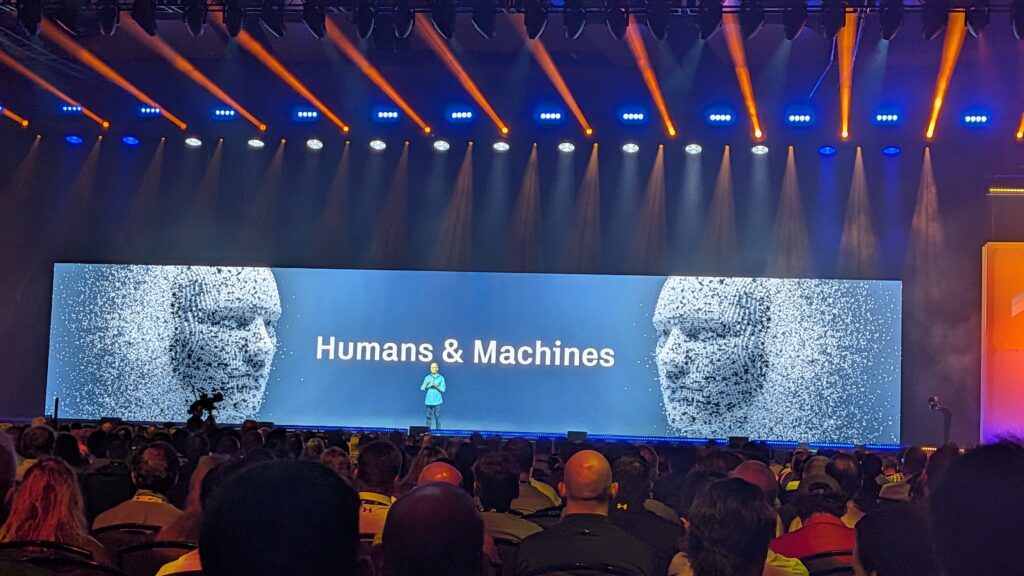
In the AI Keynote on the first day of Autodesk University, Raji Arasu, Executive Vice President and Chief Technology of Autodesk was clear: AI is no longer confined to simply following instructions or automating rote tasks. The new era of AI is defined by reasoning, adaptation, and autonomous action. Interactions are evolving to a point where human intent can be translated directly into outcomes. This transformation has the potential to redefine how we work, particularly in industries that design and make the built world.
Autodesk is entering this moment with the reimagined Autodesk Assistant—a next-generation, agentic AI partner crafted specifically for design and make professionals. Unlike the familiar but limited “help bots” of the past, the Assistant is not a pop-up helper. It is an intelligent partner that integrates into workflows, anticipates needs, and performs complex tasks in collaboration with its human counterpart. What sets it apart is its ability to combine industry-specific knowledge with seamless workflow integration, delivering not just answers but actions.
While bots like ChatGPT excel at language tasks or basic problem-solving, they lack the specialized knowledge required for reasoning about 3D geometry, physical constraints, and professional-grade workflows. Adding a general-purpose model on top of complex software only scratches the surface.
“A lot of people just bolted on an agent and called it a day. You can’t do that,” -Andrew Anagnost, Autodesk President and CEO.
“You need to have a layer that abstracts away the probability engine. What we do is, we add a layer on top of that that narrows the range of possible answers and actually takes into account the context that’s inside the application and the context of what the user is doing.”
What also differentiates Autodesk Assistant is its deep vertical integration into the industries it serves. This is not a layer bolted onto existing tools, but a foundation built on professional-grade models that understand the context of design and make. By narrowing the scope of possible answers to what is relevant in a given workflow, the Assistant minimizes the risk of hallucinations and moves toward deterministic accuracy. It does not simply generate text; it generates intelligence in context.
Equally important, Autodesk Assistant is designed for an ecosystem where AI agents communicate with one another. Through Model Context Protocol (MCP) servers and real-time discovery of data and APIs, it can collaborate across systems and organizations to execute complex tasks. In a supply chain scenario, this could mean coordinating design data, supplier inputs, and cost estimates automatically. The Assistant is not an isolated agent; it is a participant in a broader network of intelligent agents.
Arasu emphasized that one of the key benefits of Assistant is that it lives inside the environments where professionals already work, whether in Revit, Inventor, or Maya, adapting to the project at hand. By understanding the context of a design or model, it helps users solve problems faster and focus on higher-value work.
On the Future’s ‘Doorstep’
During the keynote, Mike Haley, Senior Vice President of Research, replayed a video from the 2018 keynote that imagined how generative AI could be used to design a chair. The demonstration, which was purely theoretical at the time, is now something that can actually be done through the power of generative AI.
“The future isn’t as far away as you might have thought in 2018. We are at the doorstep and knocking on the door,” said Haley.
Since 2017, the company has invested in data models and exchange connectors to ensure interoperability before AI even entered the equation. Autodesk has now built a foundation of billions of API calls that now power real-time agentic action. This is the product of years of research have lead to building new foundation models for 2D and 3D geometry that surpass the capabilities of generic language models. This is not a sudden leap, but is the culmination of sustained innovation, says Anagnost.
“I actually believe that we’re replacing ourselves. And we’re bringing our customers along with us. Just like we replaced a lot of workflows with Revit and Inventor, AI is going to become the much more dominant paradigm as you move through this.”
Autodesk Assistant represents more than just another AI feature. It is a purpose-built, vertically integrated partner designed to help professionals overcome the capacity crisis and focus on the work that matters most. As it evolves alongside neural CAD engines and interoperable AI ecosystems, it will likely become a collaborator in shaping the future.