

Contributed by Lorenzo Setti, BIM Consultant at Hitech Digital Solutions
Introduction
Construction projects have always been complex beasts. Architects working before modern tools relied on manual drawings and sketches to communicate their vision, a process that consumed massive amounts of time while errors crept everywhere. Projects kept growing larger and budgets ballooned into millions. The old methods were breaking down.
CAD emerged in the 1980s and transformed architectural practice. Precise digital drawings replaced manual drafting. Visualization improved and costs dropped as mistakes became easier to catch early. Still CAD had its limits. The software produced 2D drawings for increasingly complex buildings full of intricate mechanical systems and sustainability requirements.
Architects needed tools that matched the complexity of modern construction. Building Information Modeling brought that capability. BIM creates intelligent 3D models where every component carries detailed project data. Architects gain geometric accuracy and coordination power through models that understand how building elements relate to each other. The preconstruction phase especially benefits from this approach.
Working in 3D changes the entire design process. Clients and consultants can assess and modify designs in three-dimensional space before construction starts. Trade coordination happens early in the process. All discipline models combine into one coordinated file which speeds conceptualization and reveals clashes during design. Visualization goes deeper and sustainability analysis integrates naturally into the workflow.
BIM represents a fundamental shift in how architects design and document buildings. Technology reshapes practice at every level from client presentations to construction administration.
What are Architectural BIM Services?
Architectural BIM services encompass 3D modeling visualization, clash detection coordination, and construction documentation. These transform architectural workflows through integrated digital processes.
Definition and scope of digital construction for architects:
Digital construction enables architects to plan design and build within virtual 3D environments. Teams coordinate through shared models resolving spatial conflicts, generating schedules and calculating costs before site work begins. This virtual coordination reduces rework, improves sustainability metrics and streamlines communication across disciplines.
What challenges do architects face without Architectural BIM services?
Compressed timelines and fixed budgets create constant pressure on architectural teams. Quality documentation suffers without proper tools and experienced outsourcing partners. Manual coordination leads to errors missed deadlines and budget overruns. BIM services provide the framework modern projects need for successful delivery.
Enlisting key elements – sections, plans, material schedules, and clash detection:
Coordinated models require multiple components working together. Sections cut vertically through buildings showing spatial relationships floor heights and system routing. Plans slice horizontally revealing room layouts circulation and structural grids. Material schedules track specifications quantities and procurement data. Clash detection algorithms scan models finding conflicts between structural mechanical electrical and plumbing systems before installation.
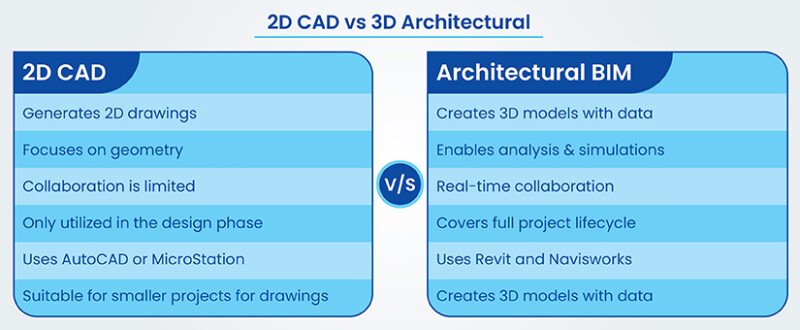
2D CAD vs 3D architectural BIM workflows – how does it compare?
CAD and BIM represent fundamentally different approaches to architectural documentation. The following table details these critical distinctions.
The Impact of Architectural BIM Workflows for Construction Cycles
With enhanced architectural BIM workflows, complex and large-scale projects become more effective and efficient. By embracing these processes and tools, architects can transform outcomes with improved project quality and error-free design causing lower rework and driven by project completion within planned time and costs.
Planning and Design Phase
The design phase is one of the most crucial aspects of modern construction. Accuracy and consistency in this stage sets the foundation for other phases. BIM workflows create an impact on this phase in the following ways:
- Improved visualization
- Real-time collaboration
- Faster design iterations
- Coordination with structural and MEP models
- Precise quantity takeoff’s and cost estimates
Construction
During the construction phase, BIM workflows play an important role in connecting BIM and field personnel and reduce change orders and RFIs to achieve seamless construction. BIM workflows create an impact on this phase in the following ways:
- Coordinate BIM and field personnel
- Reduce change orders and RFIs
Post-construction
Post construction, BIM supports project participants with a Digital Twin with data including repairs, maintenance, and renovations. This creates a space for greater efficiency, downtime reduction, and higher resource allocation. BIM workflows create an impact on this phase in the following ways:
- Create as-built models for maintenance and operations
- Make renovations and retrofitting simpler
- Enable digital twin integration with information-rich models
What Are the Benefits of Using Architectural BIM Modeling?
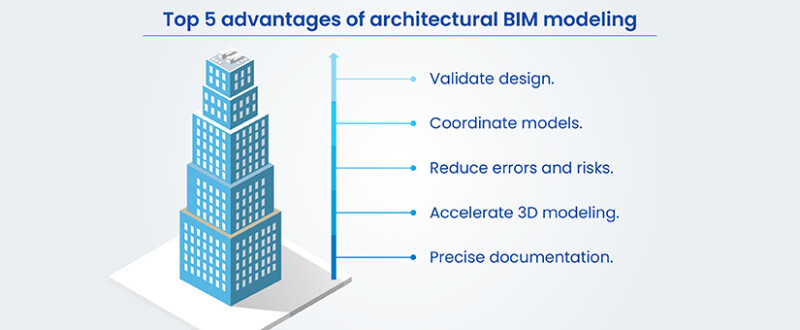
Architectural BIM modeling delivers error reduction, rework elimination, and significant time savings across project phases. Understanding the importance of architectural BIM modeling shows how the technology streamlines construction workflows while improving final deliverables saving both resources and capital throughout the building lifecycle.
Quick design validation
Early validation catches problems before they reach the jobsite. Teams verify models are error free code compliant and contain accurate cost data. Revit enables model checking and workset management while Navisworks identifies clashes between systems. This validation process prevents costly field conflicts and schedule delays.
Improved coordination between trades
Structural and MEP systems must work together without spatial conflicts. BIM coordination eliminates interferences reduces rework and keeps construction sequences on track. Disciplines share models in real time… catching problems when fixes cost pennies not thousands. This coordination drives resource efficiency smoother workflows and higher quality builds.
Reduction in construction errors and risks
Site errors threaten project health and worker safety. Virtual clash detection removes conflict sources before construction begins. Risk reduction through BIM modeling means fewer accidents less rework and predictable outcomes. Clients receive higher value deliverables while construction teams work in safer environments.
Expedited 3D modeling speed and waste reduction
Dynamo scripts and Revit APIs automate repetitive modeling tasks. These tools accelerate model creation reduce errors and ensure consistency across documentation. Teams focus on design decisions while automation handles routine work. Precise quantity takeoffs from models minimize material waste… both in fabrication shops and on jobsites.
Accurate documentation for higher ROI
Once the 3D model is clash coordinated, a complete documentation set can be extracted from it which is free of errors and holds data validity. Linking templates with the model ensures modifications are reflected automatically within the sheets.
These include site plans, sections, elevations, BOMs, BOQs, fabrication and construction drawings, and other assets with annotations, specifications, etc. Revit documentation also includes tagging, dimensioning, numbering, and creation of views that promote smart documentation. Integrating QR codes within 3D models supports faster and efficient asset tracking.
Challenges in Adopting Architectural BIM Services
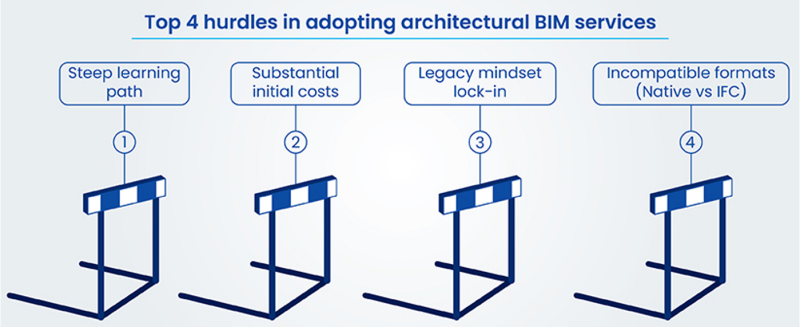
While architectural BIM services provide a series of benefits, it can also be challenging for architects to utilize its capabilities. These hurdles include:
- Complex learning curve.
- Greater initial investment.
- Resistance to change within legacy teams.
- Interoperability problems using non-compatible BIM tools.
Future of Smart Building Design with BIM
BIM has the capacity to achieve smart building design. Integrating BIM workflows and tools with technologies including AI, generative design, and BIM Level 3, with cloud-based collaboration platforms extends design and engineering capabilities of architectural BIM.
Integrating AI and generative design within architectural BIM coordination
AI transforms architectural coordination through automated decision making. Algorithms identify spatial conflicts between structural and MEP systems early. Generative design lets teams explore multiple prototypes based on specific parameters and goals. AI assesses layout performance while algorithms generate options balancing aesthetics and function. This integration produces data driven solutions architects couldn’t achieve manually.
Adopting BIM Level 3 and cloud-driven collaboration
BIM Level 3 eliminates information silos through open data standards and interoperability. Benefits include global collaboration compressed timelines and lifecycle asset management. Large projects like airports smart cities and hospitals particularly need Level 3 capabilities. Cloud software enables remote coordination with real time model access. Teams work from anywhere while maintaining efficiency. Together these technologies create connected construction frameworks for architectural teams.
Conclusion
Digital workflows are reshaping construction, and architectural BIM services sit at the center of this transformation. These tools moved past simple visualization years ago. Now they drive design intelligence enable real time coordination and optimize building performance across decades. AI integration generative design capabilities and digital twin technology position BIM as the strategic hub for construction innovation. Architecture firms that master these tools won’t just design buildings… they’ll orchestrate entire project ecosystems from concept through demolition.


