

Collecting accurate, actionable data on climate, deforestation, crop health, and other critical environmental factors is no easy task. According to Andrew Howe, OlmoEarth Program Manager at Ai2 (The Allen Institute for AI), “a lot of environmental monitoring is extremely coarse, leading to broad generalization or is still done manually.”
Howe described the data collection process as “expensive and arduous” and often “too costly and technically complex to manage.” Moreover, he stated that “Even if you have access to great remote-sensed Earth data, you’re dealing with dozens of channels across multiple satellites.”
These issues are difficult to overcome for even the most sophisticated organizations. “There are only a few organizations that have the necessary resources or technical depth to manage such complexity,” Howe asserted. “For most mission-driven organizations, it’s nearly impossible. It’s hard to fine-tune a model and get quality annotations, and even if you manage that, getting the model into a production environment can take months or even years.”
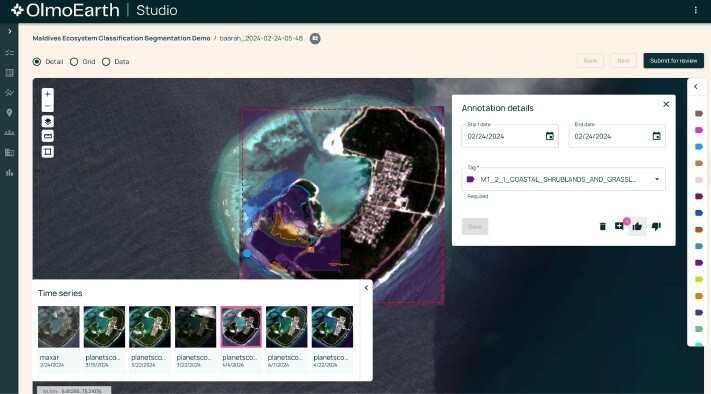
To address these problems, Ai2 has introduced the OlmoEarth platform. Ai2 calls OlmoEarth an “open, end-to-end solution that transforms global satellite and sensor data into real-time earth insight.” Offering a workflow “that spans data collection, labeling, model training, inference, and deployment,” OlmoEarth “brings cutting-edge AI to governments, NGOs, and local communities—now making it possible to monitor deforestation, assess crop health, and predict wildfire risk without deep AI expertise or specialized infrastructure.”
For Howe, OlmoEarth’s multi-modal approach is central to its effectiveness. “OlmoEarth models on a wide spectrum of multi-modal, multi-temporal data—combining radar, optical, and environmental signals to achieve best-in-class performance across various environmental domains,” he explained. “Each of these modalities captures a different aspect of the planet, and by bringing them together, the models gain a much deeper understanding of how the Earth works.”
Drawing on a real-world use case, Howe said, “You can think of it like this: radar can see through clouds, infrared captures heat and moisture, and optical imagery gives us visual patterns. When the model combines those perspectives, it can perform far more sophisticated tasks, such as detecting where mangroves are disappearing despite cloud cover, estimating soil moisture for wildfire risk, or mapping what crops are being grown in a region where no one has that data.”
For Howe, the ability to combine these perspectives is “what makes the multi-modal approach so powerful.” He asserted that this model is “similar to how foundation models in language and vision became transformative.” These models, he said, “weren’t trained for one narrow task, but instead learned broad representations that could be fine-tuned for many uses. OlmoEarth works similarly for the planet. Once it has been trained across all these modalities, we can fine-tune it with a relatively small amount of expert data to solve specific problems.”
OlmoEarth is already making an impact in the world of environmental monitoring. He reported that Ai2 has partnered with Global Mangrove Watch to “help conservationists and governments detect loss events sooner, plan restoration work, and target interventions where they’re needed most.”
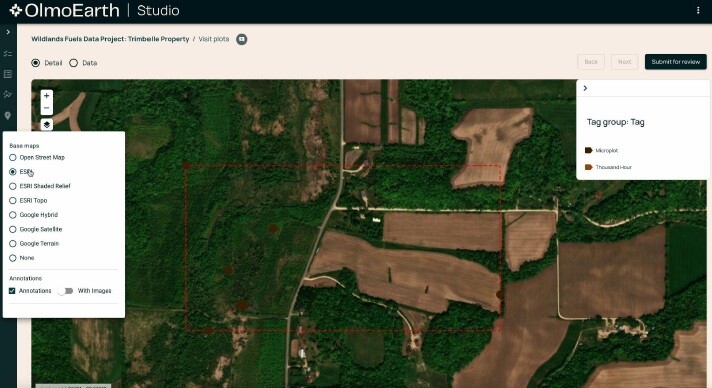
Before using OlmoEarth, Howe stated, Global Mangrove Watch took years “to collect, clean, and annotate” the data needed to update their global maps. Once OlmoEarth was applied to this work, Howe said, “that process collapsed from years to hours,” and the accuracy of the maps improved.
“They told us it felt like their ‘ChatGPT moment,’ seeing AI deliver something instantly that used to take years,” Howe reported. “What’s even more remarkable is that we achieved this using just 0.1% of their data. GMW had about 5.8 million annotated samples; we fine-tuned OlmoEarth on just 10,000 and exceeded their performance. That’s the power of a multi-modal foundation model. It already understands the Earth so well that a small amount of expert data can produce dramatic results.”
Building on this and other successes, Ai2 plans to make improvements to OlmoEarth and meet the evolving demands of the environmental monitoring community. “OlmoEarth is available as a free and open platform for mission-driven organizations, and we’re continuing to expand its capabilities,” said Howe. “Our immediate focus is on making it even easier to use—moving toward natural-language interfaces so you can literally ask questions like, ‘Show me deforestation in Indonesia over the last six months,’ and get an instant map or analysis”
In addition, Howe reported that Ai2 will continue to “scale the number of fine-tuned models and datasets on the platform, so users working on various missions, from mangrove restoration to wildfire prevention and crop monitoring, can all access tools tailored to their specific needs. We’ve already seen tremendous demand: over a hundred organizations have reached out this year alone to build on top of OlmoEarth.”
Looking ahead, Howe said that Ai2 will continue to refine and expand the capabilities and availability of the platform. “We are committed to this for the long haul,” he asserted. “Long-term commitment is one of our key strengths as an organization. We have programs that have been running for over 10 years. They continue to evolve as technology and the challenges evolve. OlmoEarth will continue to evolve in tandem with the advancement of sensing technology, the rapid development of AI, and as the urgency and priorities of the challenges shift. Making an impact requires not only the best technology. It requires ongoing support and long-term commitment.”


