Sponsored by FARO Technologies
If there’s one word that best encapsulates the world in 2025 it’s “uncertainty.” From the specter of renewed and ongoing global conflict to the possibility of a fast-tracked manned mission to Mars, it feels as if anything and everything is on the table, with both positive and negative potential outcomes.
Tariffs and the risk of retaliatory trade wars are an example of these two sides—same coin split, a fallout which has major potential implications for commercial real estate. While economists and policymakers on both sides of the Atlantic worry about heightened trade barriers, there is a real risk that rising material and construction costs could put the brakes on even commercial real estate bright spots including healthcare-related spaces, industrial properties, and data centers.
The upside of course, is that hard times necessitate creative solutions. Faced with rising costs and transnational belt-tightening, what can a company do to streamline its asset management? Increasingly, the answer has rested with reality capture solutions and automated insights.
Reality Capture for All
Together these precision measurement and jobsite photographic documentation tools, are helping commercial real estate builders and property managers oversee single project and multi-project development while at the same time, reducing operational costs and utilizing labor to better effect.
Combined, these cost-saving and time management efficiency gains could be the difference between commercial projects completed on time and on budget – despite tariff-induced price hikes – or ones that are tabled indefinitely/scrapped outright.
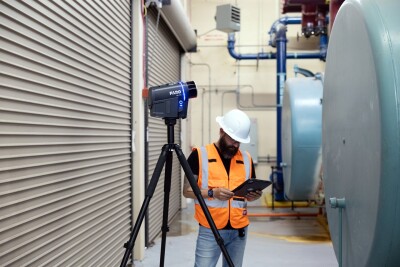
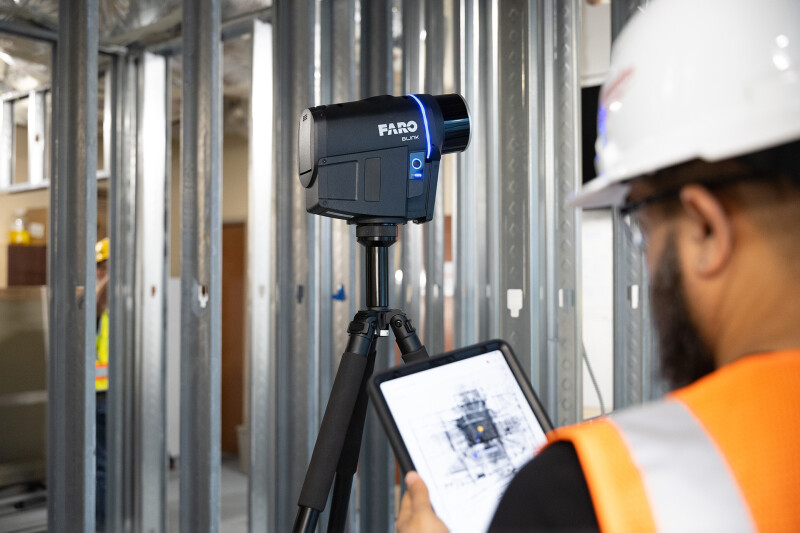
In April of this year, asset management got a major boost in the form of the FARO® Blink™ Imaging Laser Scanner, an award-winning and unparalleled reality capture solution designed for simplicity and accessibility.
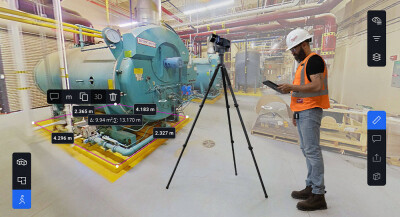
Blink brings high-quality visualization and automated workflows into the hands of designers and builders, helping teams capture, view, and share data seamlessly, regardless of expertise. At a competitive price-point, Blink can get the job done with excellent visuals built on both point cloud and 360° photos, along with the ability to share that data and gain insights via the FARO Sphere® XG cloud platform.
Compelling Use-Cases, Comprehensive Utility
In terms of asset management, a tool like Blink offers advantages in three key applications: remote monitoring and project tracking, comprehensive oversight, and on-site issue resolution, which includes the tagging, cataloguing, and annotation of physical structures in a single build or multiple projects.
Most importantly, Blink enables site visibility, allowing facility managers to remotely view and monitor a project. Designed for maximum user-friendliness, scan data is captured at a distance of up to 80m and in less than 30 seconds per position, as both a 3D scan and 360ﹾ photo of the asset is created. In a data center or industrial environment like a power plant, this could mean tracking equipment placement, identifying cabling and cooling systems, while also mapping structural layouts with millimeter accuracy.
Meanwhile, the scanner itself provides users with instant feedback and guidance during the scanning process and comes complete with a light indicator that alerts users if they’ve moved too far out of position, thus ensuring that optimal scan positions are found. This enables improved point cloud registration and ultimately scan quality. Even users who have never scanned before can readily take to this task.
Cloud-Based Collaboration
Regardless of who’s capturing the data, sharing it remotely is critical.
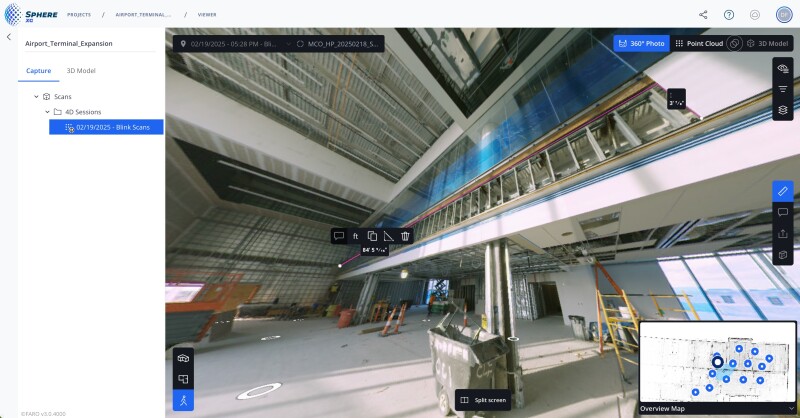
As noted above, Sphere XG, working in conjunction with the FARO Stream™ app, achieves this aim. With Sphere XG, 3D point clouds and 360° photo documentation can be viewed, shared, and insights gained all in one place. Project managers can better monitor and share this data with project stakeholders anywhere in the world, in some cases fully eliminating the need to visit on-site, once again saving time, money, and transportation costs.
Moreover, when an issue does occur on-site, say, a data center’s cooling system was positioned incorrectly, or a healthcare center’s parking garage is improperly aligned with the facility’s main building, Blink’s ability to quickly and easily capture physical assets over time allows for earlier correction and resolution – before even more work must be redone.
Last, in all three use cases, users can tag and annotate every scan and the 360° photos that Blink takes within Sphere XG. Later, this information can be filtered accordingly, monitored, and tracked. In a healthcare setting, consider the value of scanning every Automatic External Defibrillator (AED) on-site. Through Sphere XG AEDs can be accounted for and located.
A ‘Measure’ of (Some) Certainty in Uncertain Times
To be sure, solutions like Blink and a cloud platform like Sphere XG won’t herald world peace. And they won’t prevent possible trade wars.
But it’s clear their cost saving and time saving abilities, combined with their unmatched user-friendliness, could blunt some of the price hike fears and supply-chain jitters now percolating through global markets.
Just maybe, reality capture tools like these can help inject a modicum of asset management certainty into our decidedly uncertain world.
Register for a free webinar to learn more about Blink and how it could fit into your workflows, here.